Dental Implant Rejection Signs: What to Watch For
Quick answer: The main signs a dental implant is failing are an implant that feels loose, swelling or bleeding gums around it, pus or a bad taste, soreness that grows after the first weeks of healing, and gum or bone pulling back from the implant. True rejection is rare; most problems are infection or overload and can be treated when caught early.
Understanding Rejection vs. Failure in Dental Implants
The most common warning signs of dental implant rejection or failure include persistent throbbing pain, swelling that worsens after several days, visible looseness or micro-movement in the post, persistent bleeding, and active pus or discharge along the gumline. While these warning signals require prompt clinical evaluation, true immunological rejection is exceptionally rare because high-grade titanium and zirconia are biologically inert materials that the human body readily tolerates.
Instead of fighting the implant, healthy jawbone cells naturally grow directly onto the textured surface of the post. We call this fusion process osseointegration (the biological bonding where bone locks securely around the post). When everything goes as planned, the bone and the post act as one solid unit.
When a problem arises, it is almost always an integration or healing complication rather than an immune allergy. Bacterial accumulation around the gumline can lead to peri-implantitis (inflammation and tissue infection surrounding an implant). When bacteria colonize the collar of the post, the gum tissues swell, and underlying bone begins to pull away. Exploring scientific research on dental implant rejection mechanisms shows that progressive bone loss and unstable integration account for the vast majority of problematic cases.
What True Material Rejection Means
While extraordinarily uncommon, true metal hypersensitivity does exist. In these rare instances, a patient’s immune system reacts to trace elements within a standard titanium alloy.
Rather than standard localized bone loss, a systemic hypersensitivity reaction often presents with wider physical signals:
Unexplained skin rashes, hives, or eczema flare-ups
A persistent burning sensation or metallic taste in the mouth
Generalized fatigue or chronic soft tissue inflammation that does not resolve with standard hygiene
For individuals with verified metal sensitivities, metal-free ceramic zirconia implants provide an outstanding biocompatible alternative that eliminates the risk of metal-related immune responses.
Why Most Issues Are Integration or Healing Complications
The vast majority of implant complications stem from mechanical or biological hurdles during the integration phase. If bone cells cannot bond tightly to the post, the body forms fibrous encapsulation (a layer of soft scar tissue separating the bone from the implant).
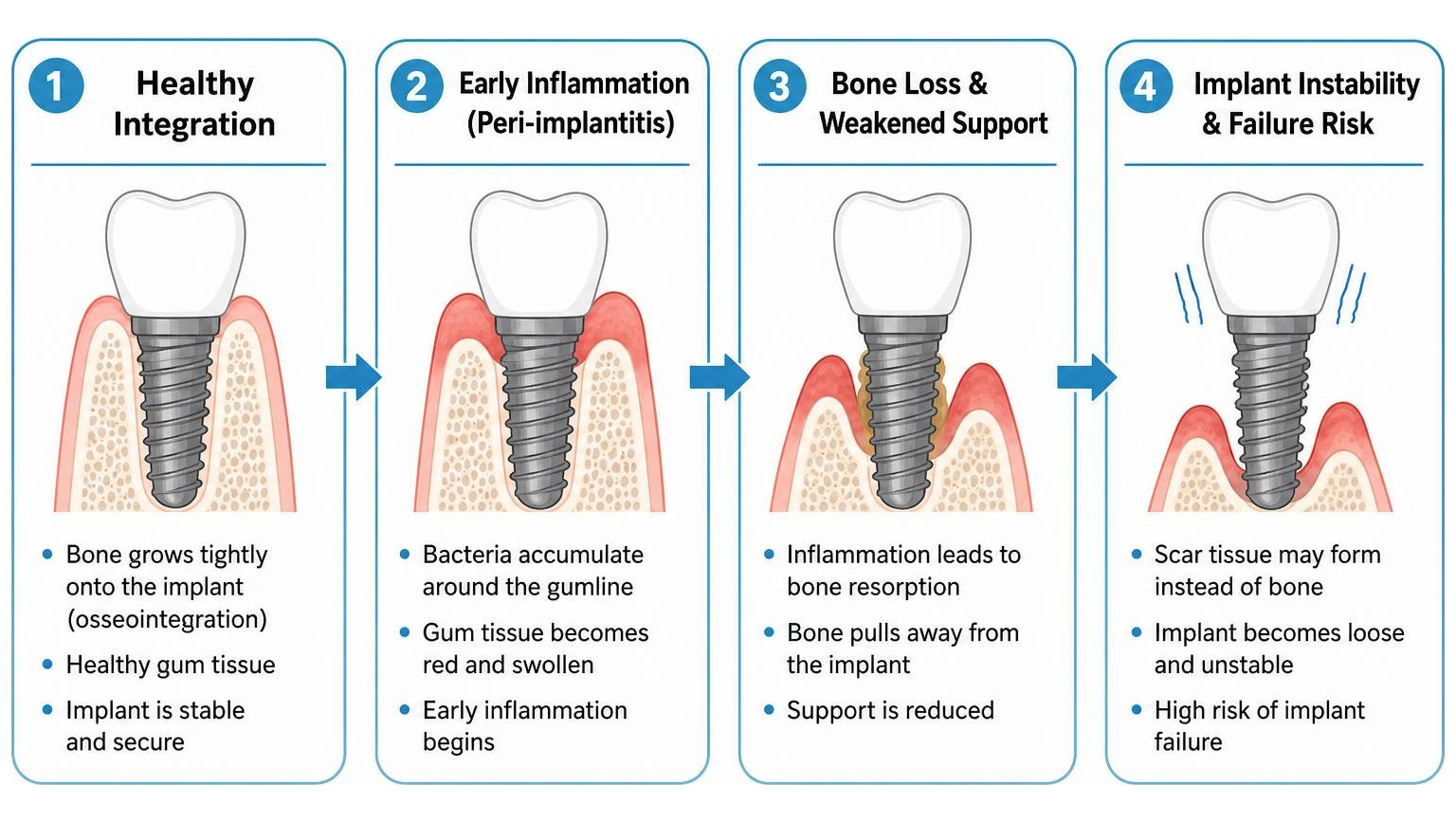
When scar tissue forms instead of solid bone, the post loses its foundation. This can happen if an implant is bumped or subjected to heavy chewing forces too early, or if early bacterial contamination disrupts healing. When evaluating patients seeking a second opinion, we often find that recognizing botched dental implants comes down to identifying poor initial stability, unmanaged gum inflammation, or placement in areas with inadequate bone density.
Critical Dental Implant Rejection Signs to Watch For
Recognizing when normal healing crosses over into an active issue allows us to intervene before minor complications cause significant bone loss. A healthy implant should feel like a natural part of your mouth—stable, quiet, and completely comfortable once the initial tissue healing finishes.
To help you distinguish between routine healing sensations and warning signals that require evaluation, use this comparison:
Symptom Category | Normal Post-Treatment Healing | Warning Signs Requiring Evaluation |
|---|---|---|
Pain Level | Mild to moderate tenderness that steadily improves over 3–5 days | Sharp, throbbing pain or discomfort that suddenly starts weeks or months later |
Tissue Swelling | Minor swelling that peaks by day 3 and resolves within a week | Swelling that expands, worsens after day 5, or spreads toward the cheek or neck |
Implant Stability | Completely firm with no perceptible movement | Any wobbling, clicking, spinning, or micro-movement when chewing or speaking |
Gum Condition | Pink, firm margins with minimal oozing during the first 24 hours | Persistent bleeding, deep redness, visible pus drainage, or gum recession |
Bite & Chewing | Even, natural contact across the dental arch | The crown feels elevated, hits prematurely, or causes a dull ache when biting |
Sensory Signals | Temporary mild numbness that fades as local numbing medication wears off | Persistent tingling, altered sensation, or a constant bad taste from drainage |
Early Dental Implant Rejection Signs During Initial Healing
The early phase covers the first few weeks to months while bone is actively knitting around the post. Paying attention to signs of dental implant rejection early on gives us the best chance to save the site.
Watch for these early warning signals:
Persistent Throbbing Discomfort: Discomfort that increases in intensity rather than tapering off after the first few days.
Prolonged Swelling: Swelling or inflammation that remains tight and red past the first week.
Micro-Movements: Any tiny shift, looseness, or rotation when your tongue touches the post.
Spontaneous Bleeding or Pus: Active bleeding beyond the first 48 hours, or yellowish discharge along the gumline.
Low-Grade Fever or Chills: Systemic signs that indicate an active local infection.
Late Dental Implant Rejection Signs and Long-Term Warning Signals
Late complications can arise months or even years after an implant has been successfully restored with a crown or bridge. These issues usually develop slowly from progressive peri-implantitis or chronic bite strain.
Key long-term warning signs include:
A Loose or Wobbly Crown: A sensation like a loose battery in a socket; any movement in an integrated implant indicates bone loss around the threads.
Visible Metal Threads or Gum Recession: Gums pulling back to expose the dark metallic edge or threads of the underlying post.
Deep Gum Pocketing: Food constantly packing around the implant neck alongside tender, easily bleeding gums.
Persistent Bad Taste: A foul, salty, or metallic taste that returns shortly after brushing, often caused by fluid draining from a hidden gum pocket.
Changes in Your Bite: Feeling as though the restored tooth is striking before your other teeth when you close your mouth.
What Causes an Implant to Loosen or Fail?
An implant requires two foundational elements to remain healthy: adequate, dense bone volume to anchor it, and a clean, balanced environment free from excessive strain and bacteria. When either of these pillars is compromised, stability drops.

Biological and Tissue Factors
The body’s natural capacity to regenerate bone tissue plays a central role in long-term implant stability. Biological challenges can compromise this healing response:
Uncontrolled Blood Sugar: Elevated glucose levels impair blood circulation and slow the cellular mechanisms needed for bone formation.
Bacterial Infiltration (Peri-Implantitis): Plaque accumulation releases toxins that trigger an inflammatory response, eroding the crestal bone around the post.
Inadequate Bone Volume: Placing an implant into thin or compromised bone without proper grafting leaves the upper threads unsupported.
Smoking and Nicotine Use: Nicotine constricts blood vessels in the oral tissues, significantly slowing cellular repair and starving the bone graft of vital nutrients. Our Smile Education Center - Dental Implants resources discuss how managing these systemic habits protects your oral health.
Thermal Bone Trauma: If bone preparation is done without adequate chilled irrigation, friction heat can compromise bone cell vitality.
Mechanical Stress and Structural Support
Implants handle vertical biting pressure exceptionally well, but they lack the natural periodontal ligament that cushions real teeth. Unbalanced forces can disrupt integration:
Bruxism and Clenching: Nighttime grinding exerts massive off-axis forces that can loosen retaining screws, fracture ceramic, or break down the bone-to-metal interface.
Off-Axis Biting Pressures: A crown or bridge that is not digitally aligned to your unique jaw movements creates uneven leverage on the underlying post.
Premature Loading: Attaching definitive teeth before the post has achieved sufficient stability can cause micro-motions that lead to fibrous scar tissue instead of bone.
Protective Custom Night Guards: For patients who grind their teeth, wearing a custom night guard helps distribute chewing forces evenly and protects the entire restoration.
How Failed Implant Work Can Be Rebuilt and Restored
Discovering that an implant is loose or failing can feel overwhelming, especially if you were told by another office that your anatomy was difficult to begin with. I want to reassure you: failed, damaged, or abandoned implant work can almost always be rebuilt.

At our Corsicana, Texas practice, we regularly treat patients who travel in from across Navarro County, Ennis, Waxahachie, Midlothian, and throughout Dallas-Fort Worth after being told elsewhere that they have "no bone left." When an implant fails and is removed, bone loss often leaves a defect. We utilize advanced treatment techniques and in-house technology to restore structural integrity and build a solid foundation.
Advanced Solutions for Severe Bone Loss
When traditional jawbone height is depleted due to previous infection or long-term missing teeth, standard short implants cannot find purchase. Rather than turning patients away, we utilize remote-anchorage solutions that bypass the deficient areas entirely:
Zygomatic Implants: Extra-long posts anchored securely into the dense, strong cheekbone (zygoma), completely bypassing severe upper jaw bone loss without requiring months of sinus grafting.
Pterygoid Implants: Implants placed at a precise angle into the solid pterygomaxillary pillar at the back of the upper jaw, providing immediate stability where bone is otherwise thin.
Transsinus and Transnasal Anchorage: Strategically angling implants through specialized anatomical corridors of dense cortical bone to secure a full arch of teeth.
Complex Bone Regeneration: Utilizing advanced structural bone grafting techniques to rebuild lost ridge height and width before or alongside implant reconstruction.
Full-Arch Reconstruction and Second Opinions
Rebuilding failed work requires exceptional precision. We eliminate guesswork by keeping the entire restorative process under one roof at our practice.
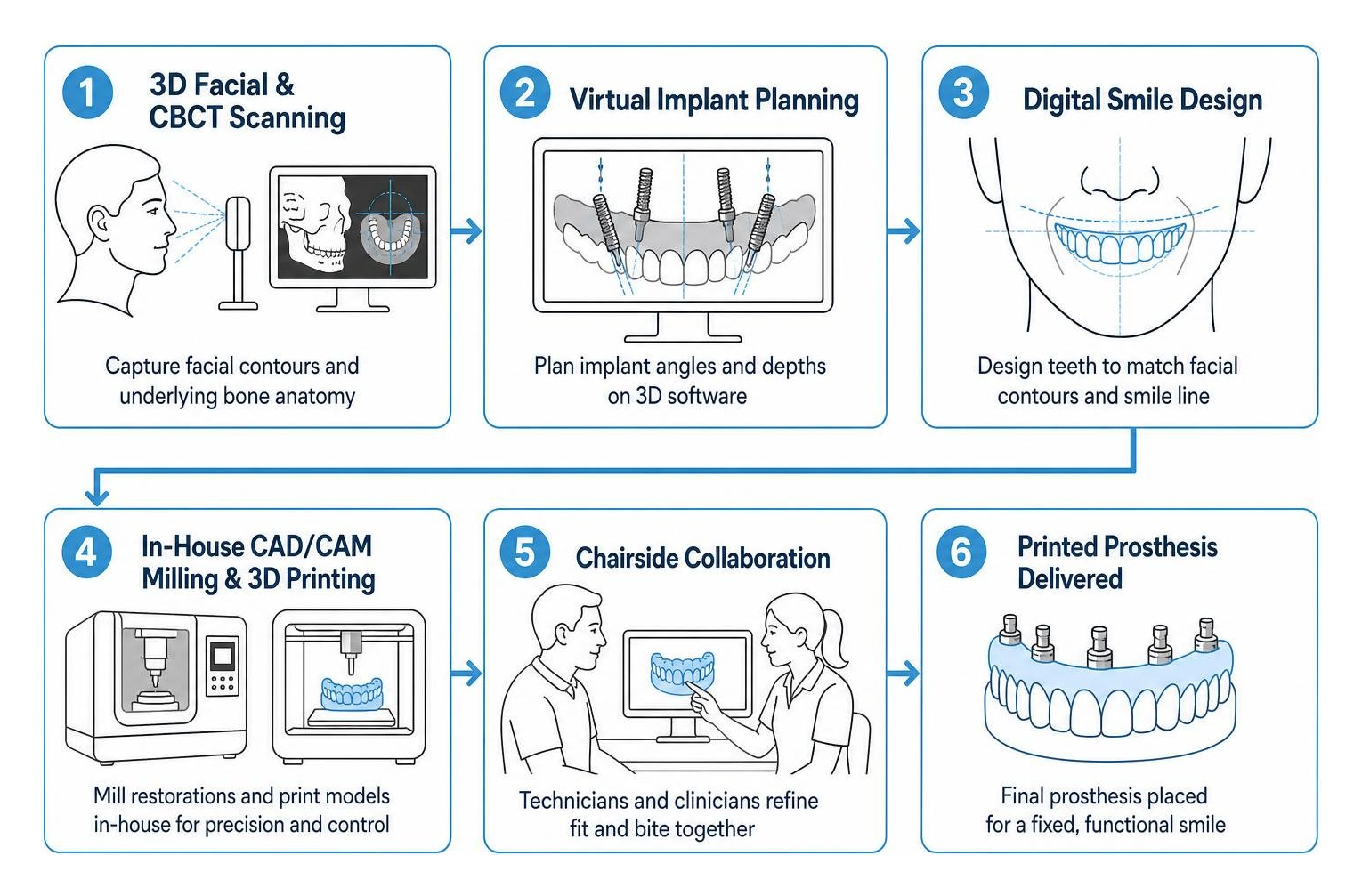
Our complete digital reconstruction workflow includes:
3D Facial and CBCT Scanning: We capture your facial contours and underlying bone anatomy simultaneously to design teeth that match your natural smile line.
Virtual Treatment Planning: Every post angle and depth is pre-planned on dynamic 3D software to maximize contact with dense bone.
In-House CAD/CAM Milling and 3D Printing: With 12 precision mills, 4 high-resolution 3D printers, and dedicated lab technicians collaborating chairside, we control the fit and bite balance of your restorations without relying on an outside lab.
Immediate-Load Teeth: For qualifying full-arch cases, our Smile-in-a-Day approach provides you with a fixed, functional set of teeth while the bone heals.
Whether you need a single replacement or full-arch dental implants, our team focuses on rebuilding your smile with precision and care.
Frequently Asked Questions About Dental Implant Complications
Can a loose or failing dental implant be saved?
In many cases, an implant experiencing early inflammation or minor bone loss can be saved if treated promptly. If the post is still firm in the bone and the issue is localized peri-implantitis, we can perform specialized deep cleanings, antimicrobial treatments, and localized bone therapy to clear the infection and tighten the surrounding gum cuff.
However, if the implant post itself is physically loose, spinning, or mobile, it means osseointegration has been lost. In that situation, the post cannot re-bond on its own and must be gently removed to protect the remaining bone. Once the area clears, we can rebuild the site for a new restoration.
Can you get a new implant after one has been removed?
Yes. Having an implant fail does not mean you are ineligible for dental implants in the future. After removing a failing post, we thoroughly clean the site, treat any lingering bacteria, and place a specialized bone graft to regenerate the socket.
Depending on your bone quality and the type of replacement planned, a new implant can sometimes be placed immediately, or after a healing time of a few months. For patients with substantial localized bone loss, using remote-anchorage options like pterygoid or zygomatic implants allows us to place solid new foundations without waiting through extended graft healing periods.
How quickly should I seek care if I notice warning signs?
You should schedule an evaluation as soon as you notice persistent pain, bleeding, or mobility. Waiting allows localized gum inflammation to travel deeper down the threads of the post, turning a manageable soft-tissue issue into extensive bone resorption.
If you are experiencing severe swelling, sudden fever, or sharp discomfort, accessing prompt emergency dental care helps preserve your natural bone structure and prevents spreading infection. We ensure you remain completely comfortable throughout your visit with gentle numbing medication and sedation options.
Conclusion
Noticing unexpected symptoms around a dental restoration is understandably stressful, but knowing what these signs mean puts you in control. Whether you are dealing with early tenderness or long-term bite changes, getting an accurate assessment is the most important step you can take to protect your health.
At Just Wright Dental and Implant Center in Corsicana, Texas, we have spent 18 years helping patients regain confidence in their smiles. With more than 10,000 implants placed, 1,000+ full-mouth implant cases, and more than 1,000 five-star Google reviews, I have seen nearly every type of implant complication—and I know that there is almost always a path forward. We regularly welcome patients seeking second opinions after complications elsewhere, offering advanced bone regeneration and remote-anchorage solutions for even the most severe bone loss cases.
If something feels off with your implant, I invite you to take a few minutes for your health and let us take a look. Book an appointment with our team today for a clear, pressure-free evaluation of your smile.
Keep reading: affordable denture options in Corsicana · emergency dentist near Corsicana · teeth whitening before and after
More Patient Guides
Emergency Dentist Guide · Before and After Gallery · What Causes Bone Loss Around Implants · Broken Implant Screw Removal · Do I Need a Bone Graft? · How to Fix Jaw Bone Loss · Implants With Gum Disease · Crooked Teeth Before and After · Teeth Whitening Before and After · Denture Options Explained · All-on-X Implants · Same-Day Full Arch · All-on-4 Implant Dentures · Denture Smile Makeover · Walk-In Emergency Dentist · Recognizing Failed Implant Work · Blue Cross Blue Shield and Implants
Explore Our Care
Dental Implants · Smile Transformations · Dentures · Cosmetic Dentistry · Emergency Dental Care · General Dentistry · Smile Gallery · About Dr. Wright · Free Smile Assessment · Book an Appointment