The Ultimate Guide to Compare All-on-X Options
Quick answer: All-on-X means a full arch of teeth held by four or more implants instead of one implant per tooth. The main choices are how many implants you need, a fixed bridge versus a removable snap-on denture, and the final material, such as zirconia. For patients with little bone, zygomatic or pterygoid implants can anchor the arch without grafting.
Understanding the All-on-X Treatment Concept
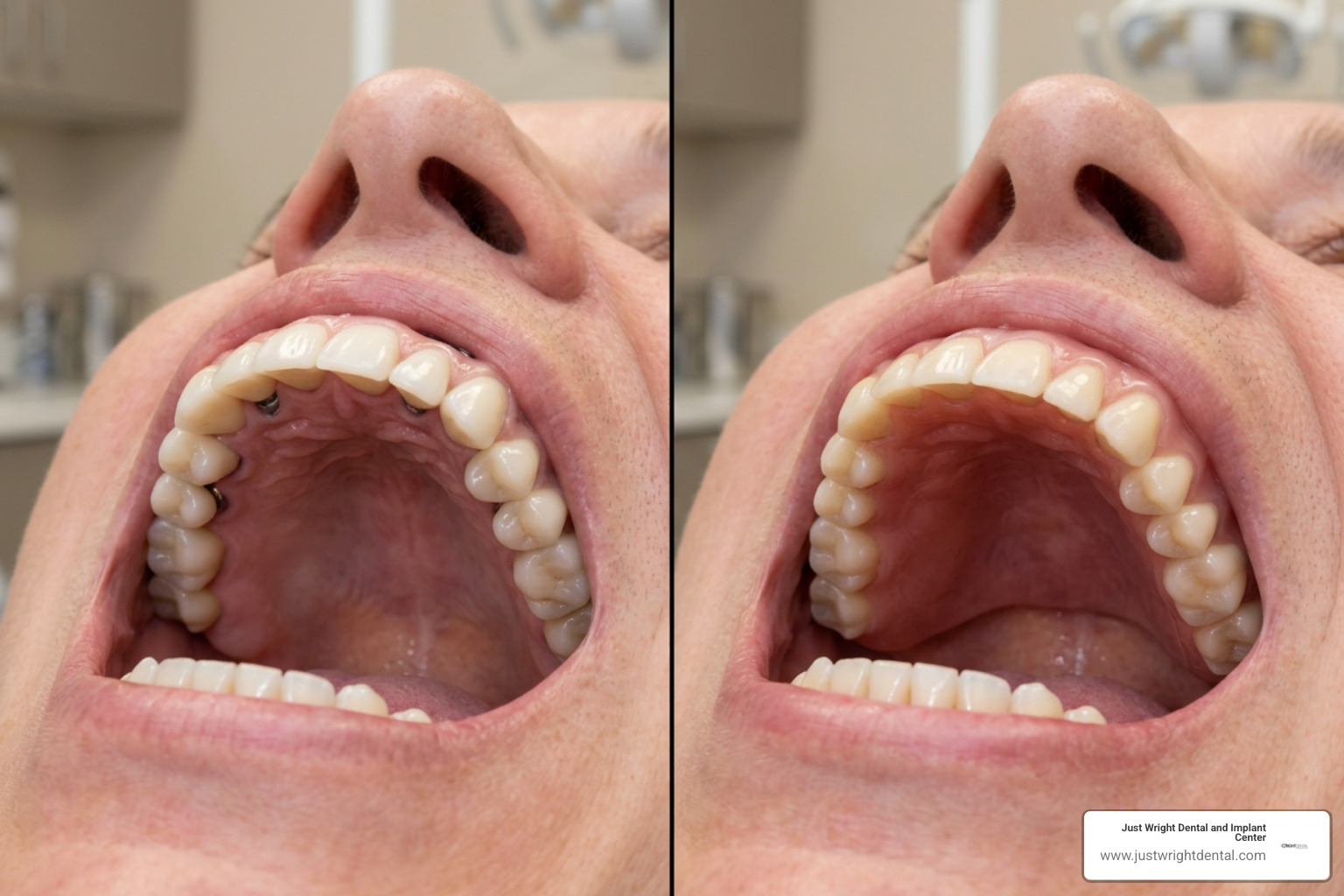
If you are tired of loose, uncomfortable, or failing teeth, All-on-X is a way to replace a full arch of teeth with a fixed implant-supported bridge. In many cases, we can remove failing teeth, place the implants, and attach a temporary set of teeth the same day, so you leave with a functional smile while your mouth heals. When you lose natural teeth, you lose more than just your smile—you lose the roots that help keep your jawbone strong and healthy. An All-on-X system replaces those missing roots by placing dental posts directly into your native bone. The letter "X" simply stands for a variable number of implants. Depending on your personal bone density, jaw shape, and bite strength, we place anywhere from four to six, and sometimes more, supportive fixtures per arch.
Each post acts as a sturdy anchor for multi-unit abutments—the specialized connector pieces that join the dental posts to your new bridge. Once connected, the teeth span across the entire arch in a process known as cross-arch stability. By connecting all the implants together beneath one solid, rigid bridge, the biting forces are shared evenly across your whole jaw. This shared support helps protect individual posts while they heal and settle into the bone.
To give you the most stable foundation possible without unnecessary complexity, we often angle the rear implants. Tilted implants make optimal use of your existing native bone, bypassing areas like the sinus cavities in the upper jaw or nerve pathways in the lower jaw. We also carefully evaluate your interocclusal space—the vertical distance between your upper and lower jaws, usually 12 to 16 millimeters—to ensure there is plenty of room to craft strong, lifelike dental implants that look and feel natural.
All-on-4 vs. All-on-X: Biomechanical Differences
You might have heard the term "All-on-4" used when researching full-arch teeth. While All-on-4 relies on exactly four posts to support an entire arch, All-on-X customizes the total number of posts to your unique anatomy.
In clinical circles, there is a well-known consideration: if a four-implant setup loses a single post down the road, the whole bridge can lose its stability. By stepping up to an All-on-X approach, we build in what engineers and dentists call biomechanical redundancy. Adding a fifth or sixth implant may provide a safety net for load distribution. If one post encounters an issue years later, your bridge may remain supported while we address it. For an in-depth clinical look at these restorative principles, you can explore this All-on-X Dental Implants: A Clinical Restorative Guide.

Candidate Screening and Diagnostic Criteria
Determining whether you are a good candidate begins with looking at your whole-body health, not just your mouth. We look for individuals who are ready to trade chronic dental pain, loose teeth, or unstable plates for a fixed, long-term treatment option.
You may be a good candidate if you experience:
Terminal dentition (teeth that can no longer be repaired with fillings or crowns).
Severe, widespread cavities often caused by chronic dry mouth (xerostomia).
Advanced periodontal concerns that have weakened natural tooth support.
Frustration with unstable, shifting removable appliances.
During our initial conversation, we also review underlying health factors such as bone density, cardiovascular health, and blood sugar balance. Systemic factors like bone-density medications or tobacco use are taken into account so we can tailor a gentle, effective healing plan that supports long-term comfort.
Comparing Full-Arch Rehabilitation Options
Choosing how to restore your smile comes down to understanding the real-world tradeoffs between everyday function, maintenance, and long-term stability.
Feature | Fixed Full-Arch Implant Bridge | Traditional Removable Appliance |
|---|---|---|
Stability | Secured to implants; designed to minimize shifting or clicking | Rests on gums; can slip while eating or speaking |
Palate Coverage | Open palate; preserves natural taste and temperature sensation | Covers the roof of the mouth with acrylic |
Jawbone Health | Directly stimulates native bone to help maintain facial shape | Does not stimulate bone; jaw gradually thins over time |
Chewing Strength | Restores strong bite force for many food types | Limited bite force; soft or sliced foods often needed |
Daily Cleaning | Brushed and flushed like natural teeth without taking them out | Must be removed daily for soaking and cleaning |
Fixed Full-Arch Restorations vs. Removable Dentures
When deciding between a fixed implant bridge and traditional removable dentures, it helps to look at two primary choices:
Fixed Full-Arch Restorations: These stay secured onto your implants day and night. Because the bridge leaves the roof of your mouth completely uncovered, you can often enjoy normal taste, natural speech, and strong chewing power. The tradeoff is that they require dedicated daily home care, such as water flossing beneath the bridge.
Removable Dentures: These sit on top of your gum tissue and can be taken in and out. While they provide an upfront solution to replace missing teeth, the tradeoff is that they do not stimulate the jawbone, which leads to gradual bone loss over time and requires periodic refitting.
Monolithic Zirconia vs. Acrylic Hybrid Prosthetics
The material used to craft your final teeth plays a major role in how long they last and how they feel. When you visit our practice for advanced cosmetic dentistry, we help you weigh the two primary materials used in full-arch bridges:
Monolithic Zirconia: Milled from a solid block of medical-grade ceramic, zirconia offers incredible strength, resists staining, and does not harbor plaque easily. The tradeoff is that it requires precise digital design and calibration so that your bite rests comfortably against opposing teeth.
Acrylic Hybrid Bridges: Made from denture acrylic wrapped around a metal framework, these bridges offer a lighter feel. The tradeoff is that acrylic is a softer material that can wear down, chip, or discolor over time, generally needing more frequent surface maintenance.
The Step-by-Step Surgical and Restorative Workflow
Modern full-arch dentistry is guided by technology, taking much of the guesswork out of your care and providing a predictable experience from day one.

Digital Diagnostics and Guided Surgery
We begin by capturing a clear 3D picture of your anatomy using our in-house low-radiation Cone Beam Computed Tomography (CBCT) imaging and digital intraoral scans. These high-resolution images show us the exact density of your bone, the position of vital nerves, and your natural facial dimensions.
Using advanced digital smile design based on 3D digital facial scans rather than stock templates, we map out the exact position, depth, and angle for every post on a computer screen before your appointment begins. We then fabricate custom 3D-printed surgical guides that place each implant precisely where planned. This completely digital workflow ensures that your new teeth align naturally with your lips, speech patterns, and facial aesthetics.

Immediate Loading and the Healing Phase
On the day of your appointment, any failing teeth are gently removed, the implants are set in place, and we secure your first set of fixed provisional teeth. This approach means you often walk out with a complete, natural-looking smile right away.
Over the next three to four months in many cases, your jaw undergoes osseointegration—the natural biological process where your bone fuses directly to the titanium posts, creating a strong foundation. During this healing time, we provide clear guidance to keep you comfortable:
First 7 Days: A gentle liquid and blended diet to give your gum tissue time to rest.
Weeks 2 to 12: A soft-food diet, meaning anything you can easily divide with a fork, such as eggs, fish, and pasta, to prevent excessive pressure on the implants while they fuse.
Final Delivery: Once our digital measurements confirm that the posts are fully integrated, we design and deliver your custom zirconia bridge.
Investment Factors and Clinical Risk Management
Investing in your oral health is one of the most important decisions you will make for your overall well-being, speech, and nutrition.
Key Factors Influencing Total Investment
Every patient's mouth is unique, which means the total health investment for full-arch care varies based on several clinical factors:
Anatomical Complexity: Patients with severe bone loss may benefit from specialized remote-anchorage implants—such as zygomatic implants that anchor into the cheekbone or pterygoid implants that anchor into strong bone behind the upper jaw—which may reduce the need for extensive bone grafting.
Material Selection: High-durability materials like monolithic zirconia represent a different long-term health investment than traditional acrylic options due to their strength and resistance to wear.
In-House Technology: Completing your entire care under one roof—from 3D imaging to 100% in-house CAD/CAM milling and 3D printing without outside labs—streamlines the process and supports fit, speed, precision, and quality control.
Sedation Planning: For patients who feel anxious or need a longer full-arch appointment, we offer sedation with a board-certified anesthesiologist so your comfort and safety can be carefully monitored.
Long-Term Maintenance Protocols for All-on-X
Your new implants cannot get cavities, but the gum and bone tissue around them still need proper daily care. Without routine hygiene, bacteria can cause peri-implantitis, a form of gum inflammation that weakens the bone around the posts.
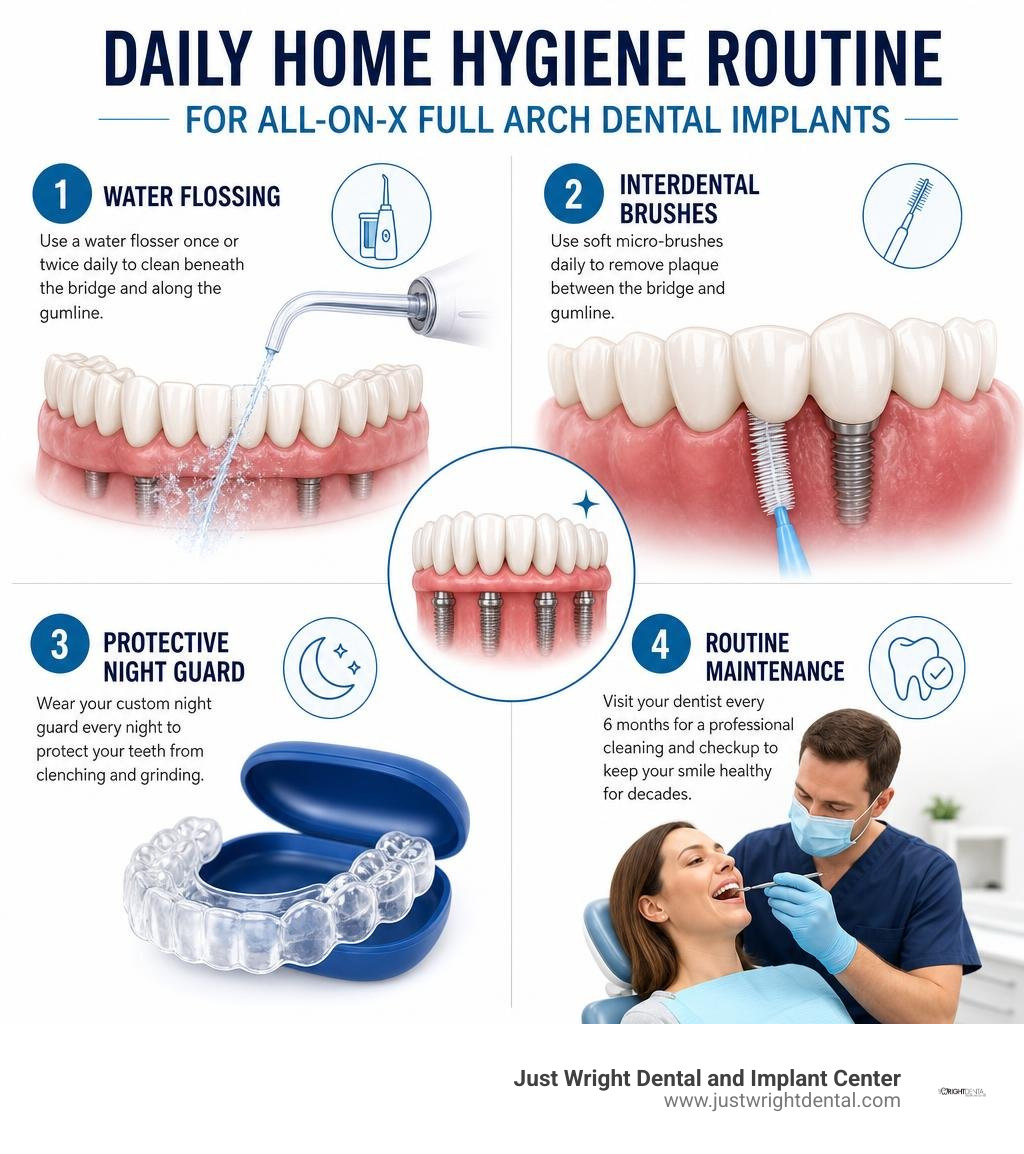
Keeping your investment healthy over the long term involves simple, disciplined daily habits:
Water Flossing: Use a pressurized water flosser once or twice daily to sweep away food particles and plaque from underneath the bridge.
Interdental Brushes: Soft, specialized micro-brushes slide easily between the bridge and gumline for targeted cleaning.
Protective Night Guards: A custom-fitted night guard helps protect your porcelain or zirconia teeth from nighttime clenching and grinding.
Routine Maintenance Visits: Professional cleanings every six months allow our team to check the health of your gum tissue, test the tightness of internal screws, and keep your smile shining bright.
Frequently Asked Questions About Full-Arch Restorations
How Long Do Full-Arch Dental Implants Last?
With proper daily hygiene and regular dental checkups, titanium implant posts placed in the jawbone can last for many years. While the titanium foundations may stay secure for decades, the attached prosthetic bridge can experience natural surface wear over 10 to 15 years, at which point it can often be polished, refreshed, or updated without disturbing the underlying posts.
What Is the Dietary Protocol During Osseointegration?
During the first three to four months after your treatment in many cases, your bone is actively bonding to the implant surfaces. To prevent micromotion—tiny shifts that can interrupt this bonding process—we place you on a soft-food diet. If you can easily divide the food with the side of a plastic fork without applying heavy force, it is often safe to eat. Once your final bridge is secured, many patients can return to enjoying a wider range of favorite foods, including crisp apples, nuts, and steaks.
Can Full-Arch Rehabilitation Be Completed Without Bone Grafting?
Yes, many full-arch treatments can be performed without traditional bone grafting. By strategically angling the posterior implants into your densest native bone, we maximize natural stability while avoiding the maxillary sinuses. For individuals with advanced upper jaw bone thinning, specialized techniques like remote-anchorage implants may allow us to secure a full smile safely without months of preliminary graft healing.
Conclusion
Restoring your smile is about much more than fixing teeth—it is about waking up every morning with less dental worry, enjoying meals with the people you love, and sharing your smile with genuine ease. At Just Wright Dental and Implant Center in Corsicana, TX, founded in 2010, we believe in treating the whole person, not just the teeth.
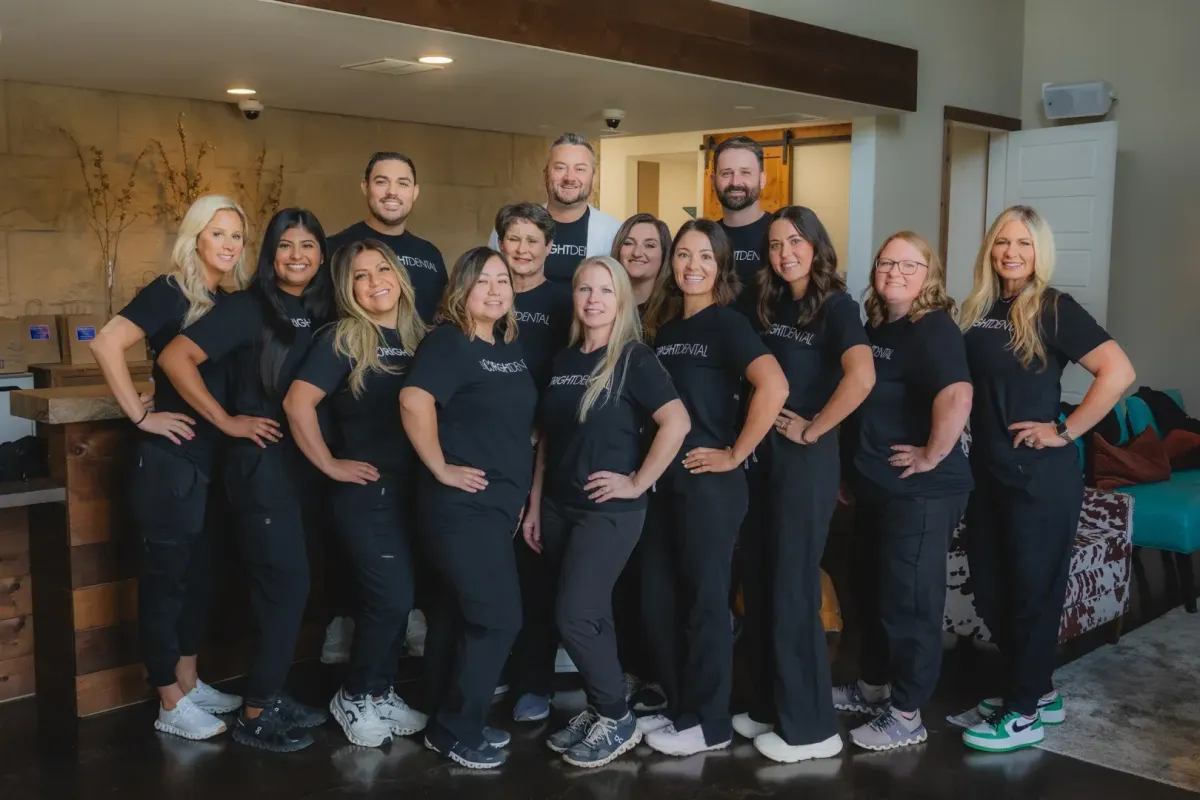
Whether you are visiting us from right here in Navarro County, traveling from nearby communities like Mildred, Eureka, Ennis, Fairfield, Waco, and Tyler, coming in from DFW and East Texas, or traveling from elsewhere nationwide, our team of 18 to 20 compassionate professionals provides comprehensive, judgment-free care under one roof. We also coordinate oncology dental clearances with Texas Oncology and MD Anderson when that support is needed. With more than 10,000 implants placed and about 200 full-arch cases completed yearly, our fully integrated in-house digital laboratory includes in-house CBCT imaging, 12 CAD/CAM mills, and 4 3D printers, allowing us to handle every step of your smile transformation with precision and care.
If you are wondering what is possible for your health, we invite you to take a few minutes to talk with us. Book An Appointment today so we can sit down together, explore your options, and design a personalized path toward a healthy, comfortable smile.
Keep reading: affordable denture options in Corsicana · emergency dentist near Corsicana · teeth whitening before and after
More Patient Guides
Emergency Dentist Guide · Before and After Gallery · What Causes Bone Loss Around Implants · Broken Implant Screw Removal · Do I Need a Bone Graft? · How to Fix Jaw Bone Loss · Implants With Gum Disease · Crooked Teeth Before and After · Signs of Implant Rejection · Teeth Whitening Before and After · Denture Options Explained · Same-Day Full Arch · All-on-4 Implant Dentures · Denture Smile Makeover · Walk-In Emergency Dentist · Recognizing Failed Implant Work · Blue Cross Blue Shield and Implants
Explore Our Care
Dental Implants · Smile Transformations · Dentures · Cosmetic Dentistry · Emergency Dental Care · General Dentistry · Smile Gallery · About Dr. Wright · Free Smile Assessment · Book an Appointment