What Are My Full Arch Dental Implant Options and Costs?
Full arch dental implants replace a full row of teeth using implants in the jaw to support replacement teeth. Your options center on a permanent, custom fixed bridge secured firmly to your jaw. The right fit, and the investment involved, depend on your bone health, the type of teeth you choose, and your treatment plan.
At our Corsicana office, we use 3D scans to plan implant placement and design a smile around your face. If you've been told you don't have enough bone, I can also assess whether advanced implant placement may be an option for you.
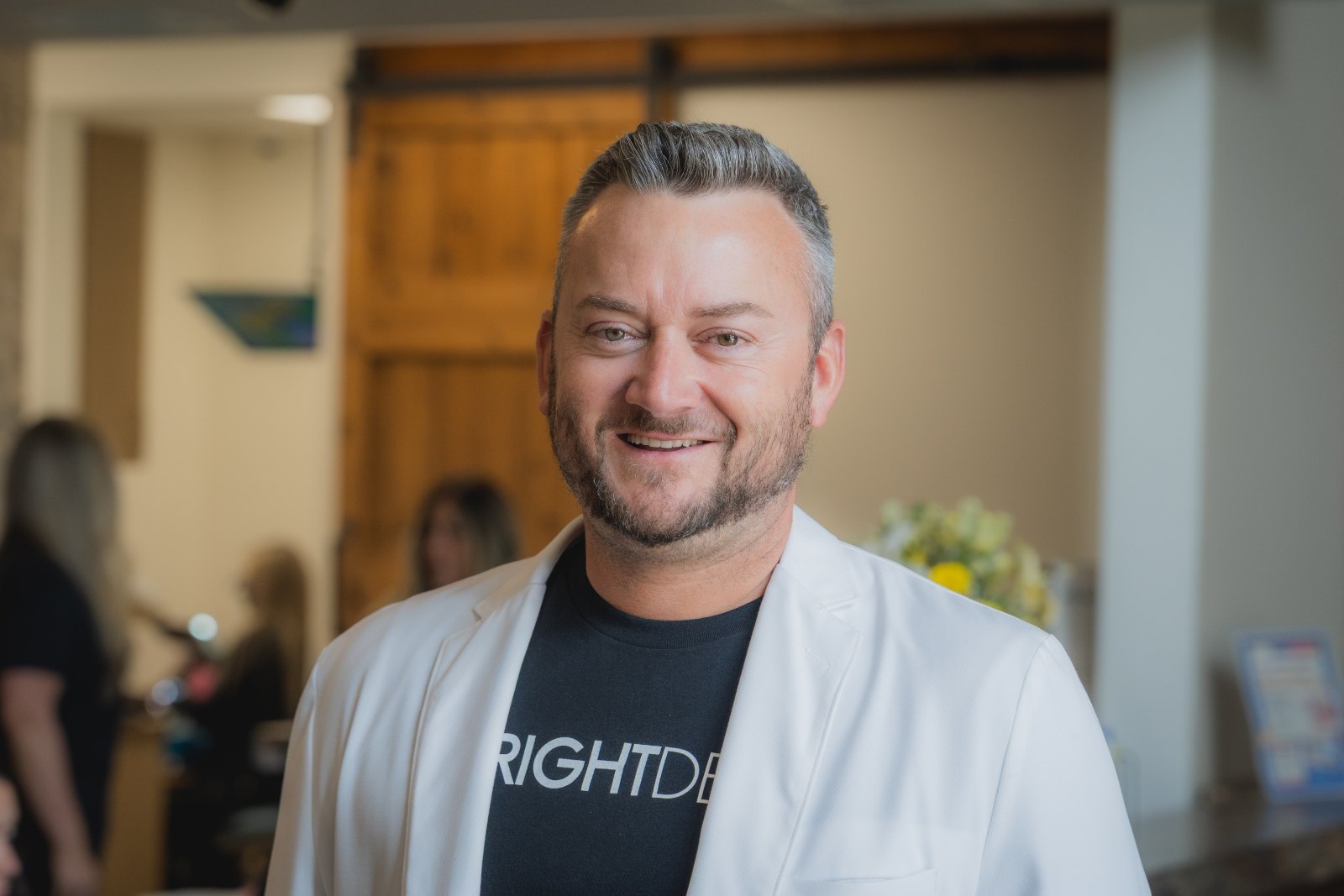
I'm Dr. Justin Wright, DDS, founder of Just Wright Dental and Implant Center. I've placed more than 10,000 implants and treated more than 1,000 full-mouth implant cases; below, I'll explain your full arch dental implants options and what shapes your investment.
What Are Full Arch Dental Implants and How Do They Work?
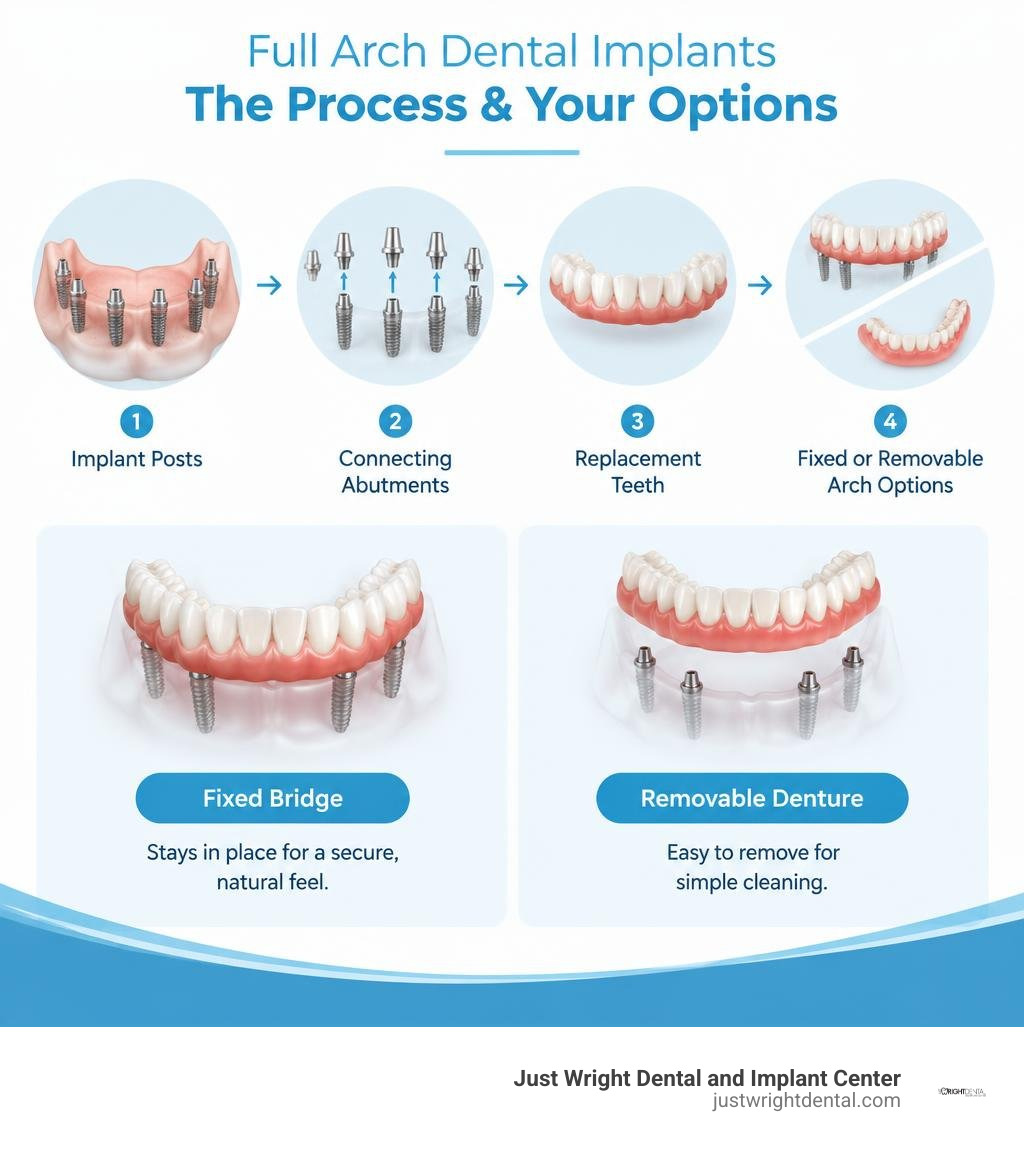
Full arch dental implants restore an entire upper or lower dental arch using strategically positioned artificial tooth roots that anchor a custom set of prosthetic teeth. Instead of placing a separate post for every single tooth, this approach uses a small series of posts to secure a full, stable bridge across the jawline.
When you lose natural teeth, your jawbone naturally begins to shrink over time because it no longer receives stimulation from chewing roots. Implant posts act just like natural roots, transferring chewing pressure directly into the bone to help maintain your facial height and jaw structure.
Key Components of Full Arch Dental Implants
A complete full-arch restoration system relies on three precision parts working together:
Biocompatible Implant Posts: Small, medical-grade titanium cylinders placed directly into the jawbone that serve as solid foundation anchors.
Multi-Unit Abutments: Specialized connector pieces that sit on top of each implant post, correcting angles and creating a level platform to secure your new teeth.
Monolithic Custom Bridge: The visible arch of teeth, custom milled or printed to match your natural smile line, gum contours, and facial symmetry.
Clinical research, such as the Full-Arch Implant Restoration overview by Dr. Arun K. Garg in Dentaltown, shows that using angled posts allows restorative dentists to maximize existing bone contact without requiring extensive preparatory surgeries.
Single Tooth Replacement vs. Full Arch Dental Implants
A single tooth implant replaces an isolated missing tooth using one titanium post, one abutment, and an individual porcelain crown. This method is great for isolated gaps, but replacing ten or twelve missing teeth side-by-side with individual posts is neither practical nor necessary.
Full arch restorations distribute bite forces evenly across four to six posts, functioning much like pillars supporting a sturdy bridge. When you need comprehensive dental rehabilitation, our dental implants provide a unified, balanced foundation that supports your bite.
What Types of Full Arch Implant Solutions Are Available?
Full arch solutions focus primarily on permanent fixed bridges that stay in your mouth continuously, though patients sometimes ask about removable snap-on overdentures. Your bone volume, aesthetic preferences, and lifestyle needs will guide which option fits best.
Fixed All-on-X and All-on-Four Systems
Fixed full-arch systems secure a solid bridge directly to four, five, or six implant posts using prosthetic screws. These teeth remain in place day and night, meaning you brush and clean them just like natural teeth without taking them out.
Our patients often choose All-on-X or All-on-Four dentures because the rear implants are tilted to grip strong, dense bone. With our same day full arch workflow, we design and mill your provisional teeth right in our Corsicana lab so you leave with fixed teeth on surgery day.
Implant-Supported Snap-On Overdentures
Implant-supported overdentures combine implant stability with a removable appliance that snaps onto locator attachments anchored by two to four implants.
Patients exploring a denture smile makeover appreciate that these restorations can often be made without a bulky roof-of-the-mouth plate. Using our denture digital smile workflow, we design the teeth to support your lips and cheeks naturally.
Remote Anchorage for Severe Bone Loss
If you've suffered advanced bone deterioration or have been wearing traditional dentures for decades, you might have been told elsewhere that you have "no bone" left for implants. In these situations, I utilize remote-anchorage implants—including zygomatic, pterygoid, transsinus, and transnasal posts—that anchor into the cheekbone and dense facial skeleton.
Our bone loss dental implants guide explains how these specialized techniques bypass the need for major bone grafting. If you're wondering whether you require preliminary tissue rebuilding, do I need bone graft for implant provides helpful answers on how we assess bone levels on a 3D CBCT scan.
Full Arch Implants vs. Traditional Dentures: What Are the Key Benefits?
Full arch dental implants provide unmatched security, natural chewing strength, and facial bone protection compared to standard suction-based dentures.
Feature | Full Arch Dental Implants | Traditional Removable Dentures |
|---|---|---|
Stability | Anchored firmly in bone; zero slipping or shifting | Rests on gums; relies on adhesives or suction |
Chewing Power | Restores near-natural bite force for tough foods | Significantly reduced bite force; diet limits |
Jawbone Health | Stimulates bone tissue to prevent atrophy | Ongoing bone resorption and shrinking ridge |
Roof of Mouth | Open palate for natural taste and speech | Covered palate alters taste sensations and speech |
Maintenance | Brushes like natural teeth; professional cleaning | Nightly removal, soaking, relining every 5–8 years |
Because traditional dentures sit on top of the gums, they don't stop underlying jawbone shrinkage. Over time, that shrinkage leads to loose appliances, sore spots, and a sunken facial appearance. Supporting your smile with implants helps maintain implant longevity and preserves your youthful facial profile for years to come.
What Factors Influence the Cost and Insurance Coverage for Full Arch Treatment?
The total investment for full arch treatment depends on your jaw anatomy, the number of implants required, the materials used for your bridge, and whether you need remote-anchorage posts. Choosing durable, high-translucency zirconia milled in-house creates a strong, lifelike result that withstands heavy chewing forces.
At our Corsicana practice, we keep everything under one roof: 3D scanning, surgical placement, and in-house CAD/CAM milling. By fabricating your prosthetics on our own 3D printers and milling units, we cut out third-party commercial dental lab markups and maintain total quality control.
When planning your health investment, dental insurance sometimes covers individual portions of the care, such as extractions or surgical components. Medical insurance sometimes covers procedures involving bone reconstruction, the removal of underlying infections, or severe TMJ functional deficits. Our team reviews your specific plan details to identify all available benefits. You can explore our smile transformations to see how our personalized approach changes lives.
What Does the Step-by-Step Procedure and Recovery Look Like?
The full arch treatment process begins with detailed diagnostic planning and moves through gentle surgical placement to your final custom smile delivery.
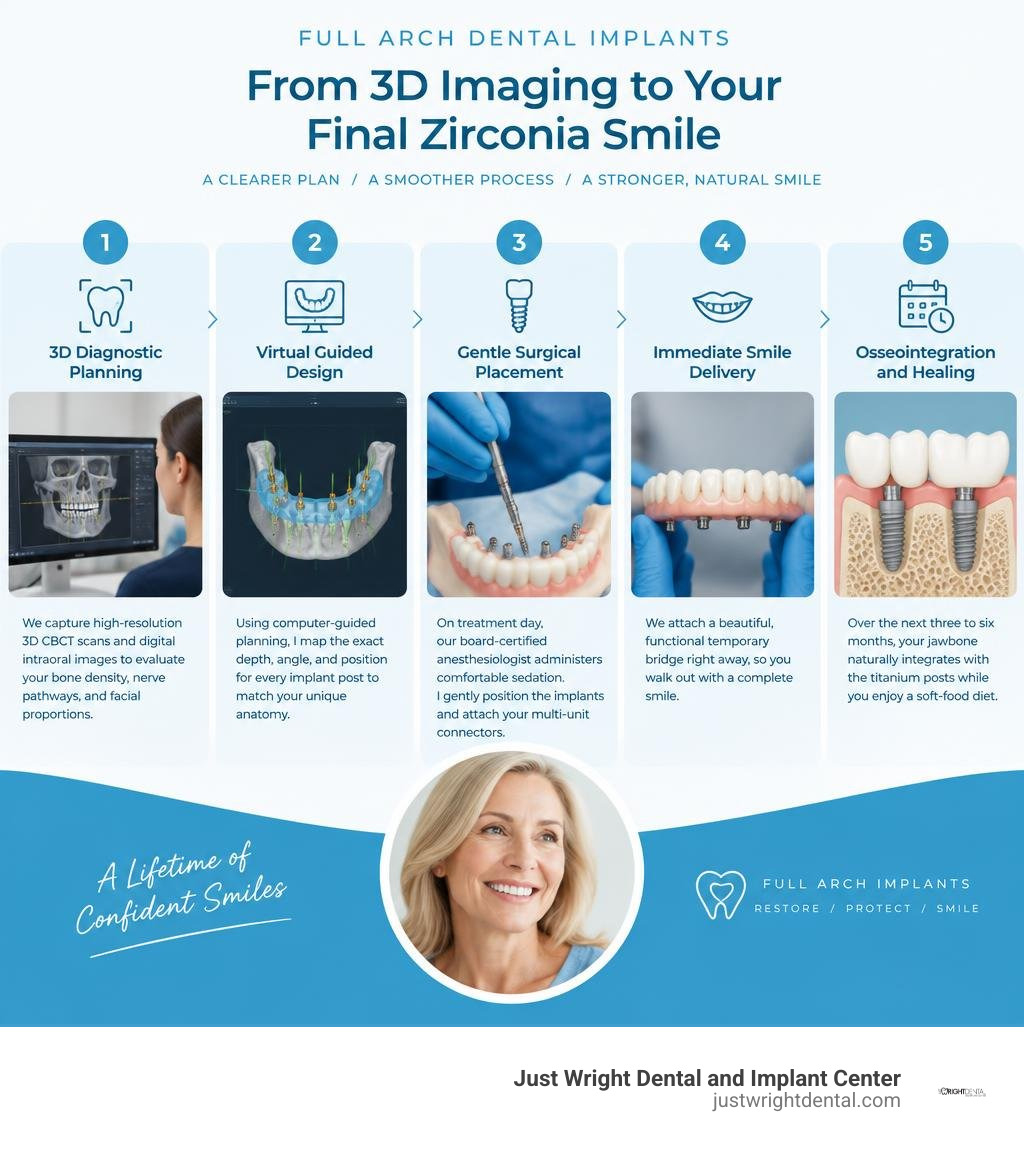
3D Diagnostic Planning: We capture high-resolution 3D CBCT scans and digital intraoral images to evaluate your bone density, nerve pathways, and facial proportions.
Virtual Guided Design: Using computer-guided planning, I map the exact depth, angle, and position for every implant post to match your unique anatomy.
Gentle Surgical Placement: On treatment day, our board-certified anesthesiologist administers comfortable sedation. I gently position the implants and attach your multi-unit connectors.
Immediate Smile Delivery: We attach a beautiful, functional temporary bridge right away, so you walk out with a complete smile.
Osseointegration and Healing: Over the next three to six months, your jawbone naturally integrates with the titanium posts while you enjoy a soft-food diet.
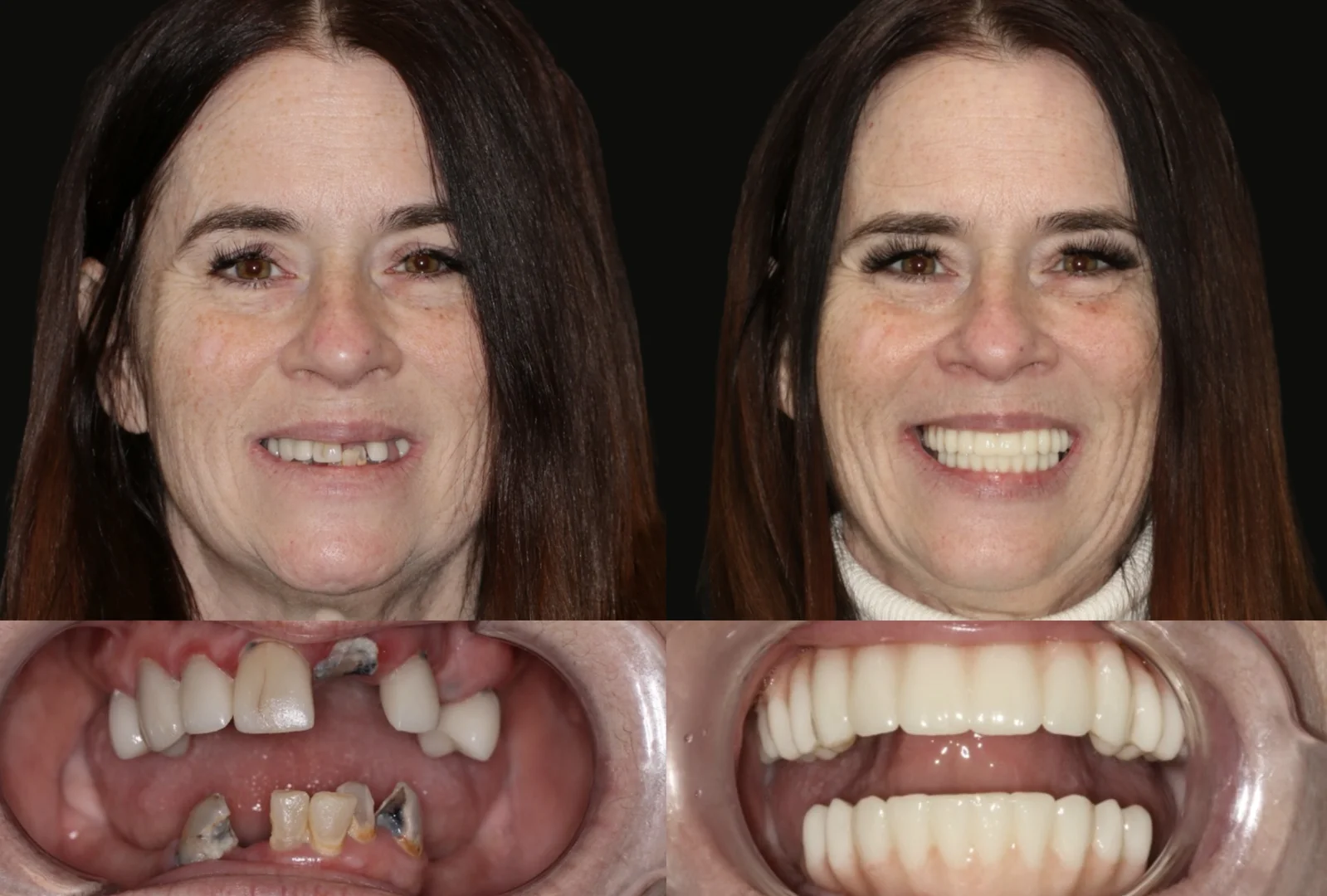
Final Custom Bridge: Once healing is complete, we design and mill your final monolithic zirconia bridge, checking every contour for perfect comfort. You can see real patient results in our before after gallery.
Frequently Asked Questions About Full Arch Restorations
How many implants are needed for a full arch?
Most full-arch restorations require four to six implants per jaw. The exact number depends on your bone density, jaw shape, and bite mechanics. Placing posts at specific angles helps provide stable support without overloading any single area.
Can I remove my full arch dental bridge at home?
No, you can't remove a fixed full-arch dental bridge at home; it's secured directly to the implants with prosthetic screws and is only removed by a dentist during routine cleanings. This screw-retained design helps keep your teeth stable when eating and speaking.
How long does the healing process take after surgery?
Initial soft tissue healing typically takes one to two weeks, during which most swelling and tenderness subside. Complete bone fusion, known as osseointegration, often takes between three and six months while you comfortably wear your provisional bridge.
Am I a candidate if I have been told I have severe bone loss?
You may still be a candidate even with severe bone loss. Using advanced remote-anchorage implants like zygomatic and pterygoid posts, I can anchor your bridge into denser cheekbone areas, often reducing the need for extensive bone grafting.
Does insurance cover the full arch procedure?
Insurance sometimes covers specific phases of full-arch treatment, such as preparatory extractions, sedation, or portions of the surgical placement. Medical insurance sometimes covers treatment when bone loss stems from trauma, severe disease, or reconstructive needs.
Reclaim Your Smile with Advanced Full Arch Solutions
Restoring your smile with full arch dental implants is an investment in your health, confidence, and daily quality of life. Whether you live right here in Corsicana, commute from Ennis or Waxahachie, or drive in from elsewhere in Texas, our team delivers compassionate, judgment-free care tailored to your face and anatomy.
Text or call our Smile Transformation Coordinator at 903-602-3439, or call our office at 903-872-8422. Take your next step and BOOK YOUR FREE SMILE ASSESSMENT or schedule your All-on-X consultation with us today.
Written by Dr. Justin Wright, DDS, founder and clinical director of Just Wright Dental and Implant Center in Corsicana, Texas.