What Is a denture digital smile?
How a Denture Digital Smile Helps You Preview a Natural-Looking Smile
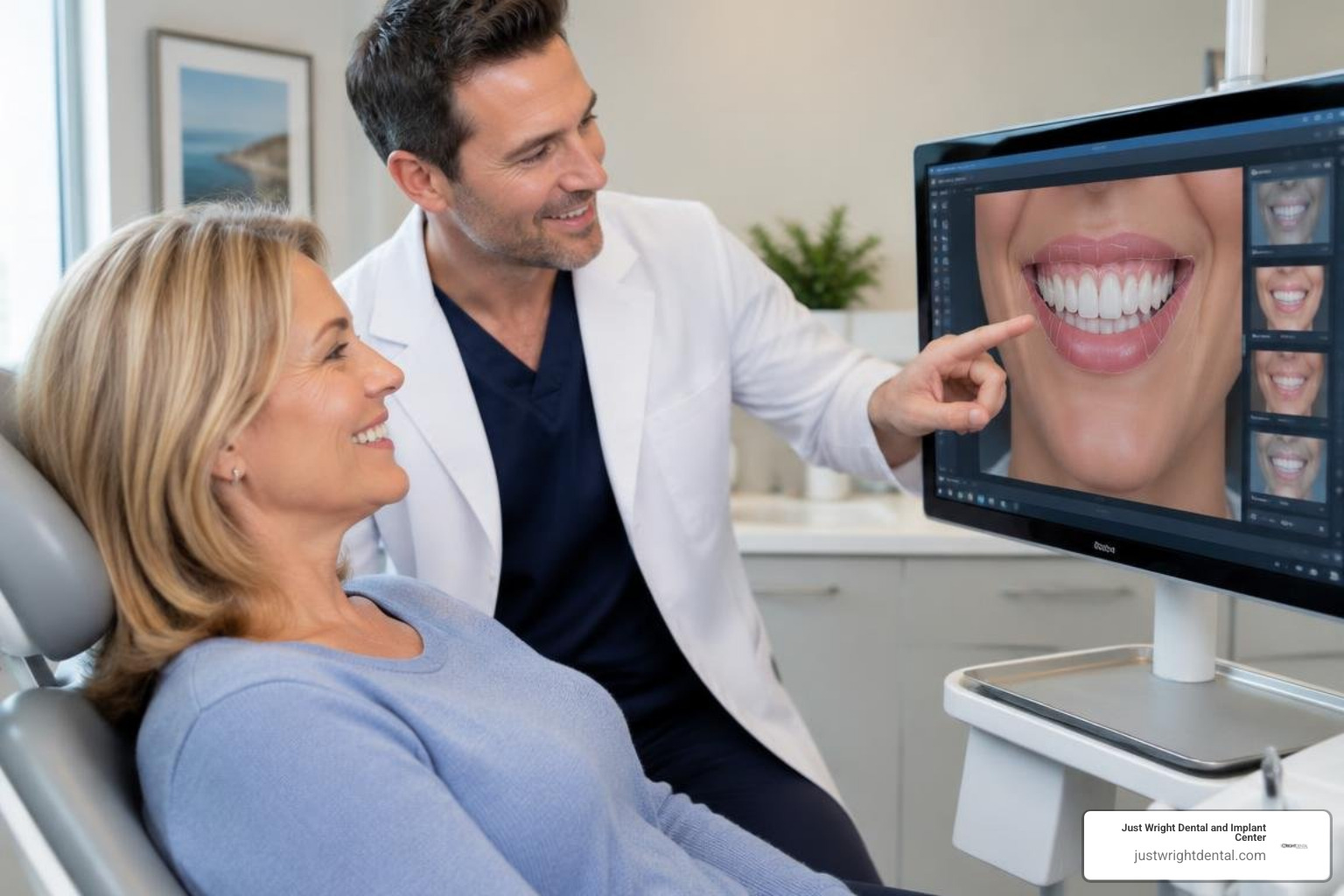
A denture digital smile uses photos, digital mouth records, and facial measurements to plan where denture teeth should sit before the final denture is made. Instead of choosing a stock tooth setup and waiting until the try-in to judge the look, you can review a smile preview and make changes to details such as tooth shape, tooth display, midline position, and smile curve.
I use this planning to match the denture to your face, lips, and natural smile style. The process can include a digital scan, facial photos or a facial scan, computer-based tooth design, and a try-in denture so we can check appearance, bite, comfort, and stability before final fabrication.

I'm Justin Wright, DDS, and I've placed more than 10,000 implants and completed more than 1,000 full-mouth cases using an in-house digital workflow. In the next sections, I'll show you how a denture digital smile is planned, tested, and made.
What Is a Denture Digital Smile and How Does It Work?
If you worry that replacement teeth will look artificial or generic, a denture digital smile addresses that by building the teeth around your facial features. It combines 3D facial records, intraoral scans, and software simulations to plan tooth shapes, proportions, and positions before physical manufacturing begins.
We map key facial landmarks, including the line between your pupils, your lip posture, and the center of your face. By combining these records with digital scans of your gum ridges, we design teeth that complement your bone structure and skin tone. This facially driven approach to cosmetic dentistry supports predictable results. Rather than hoping a standard denture mold fits your profile, scientific research on digitally designed replacement dentures shows that aligning virtual teeth with real facial anatomy produces an authentic, natural appearance.
Step-by-Step Denture Digital Smile Design Workflow
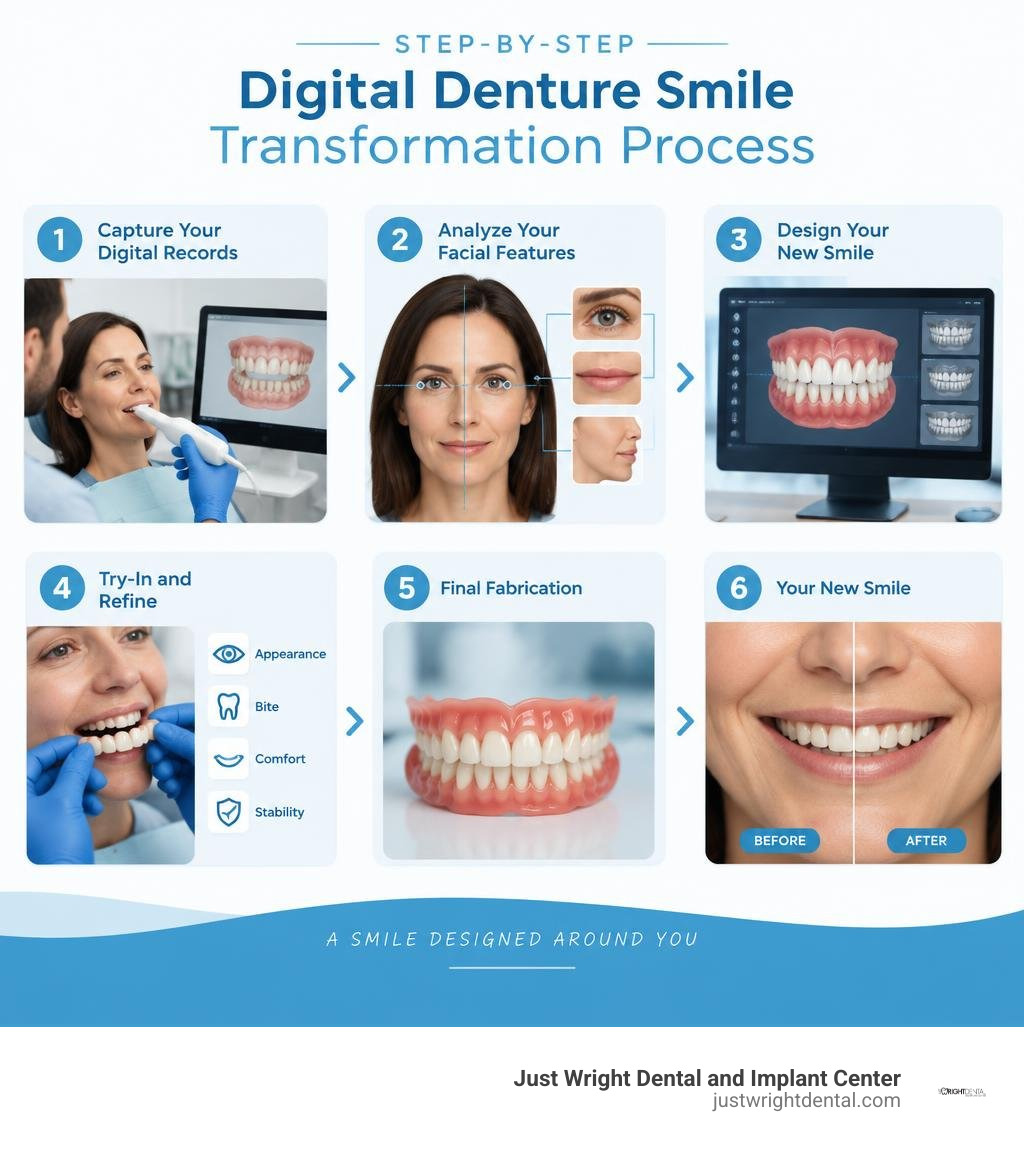
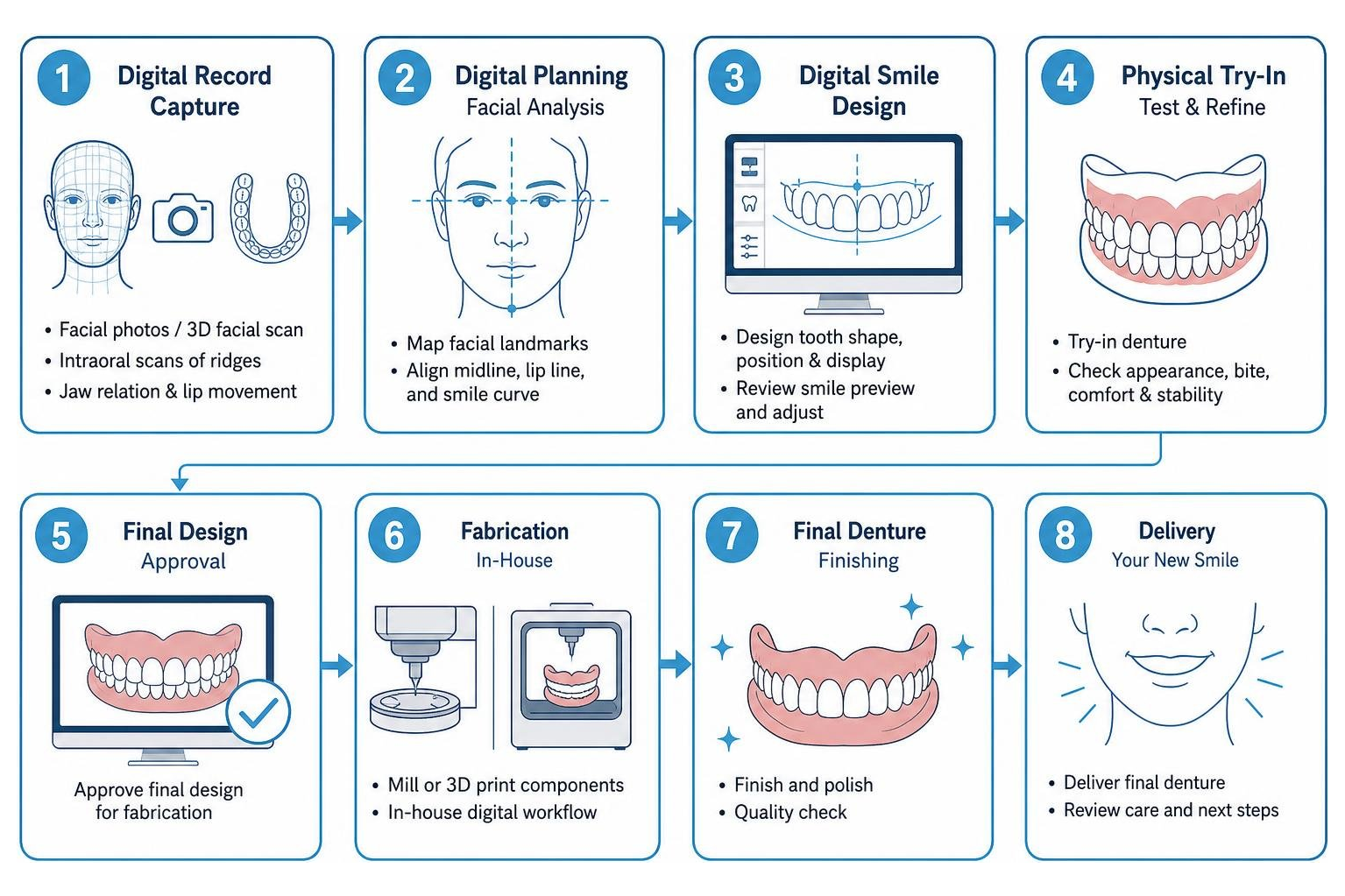
You might wonder how we transition from a screen simulation to a physical smile you can wear. The workflow follows a structured sequence: capturing digital records, planning in software, testing a physical try-in, and crafting the final restoration.
Digital Record Capture: We take high-resolution facial photographs, a 3D facial scan, and detailed digital scans of your oral ridges, capturing jaw relation records and natural lip movement.
Landmark Mapping & Virtual Setup: In CAD/CAM design software, we map the facial midline, smile arc, and lip line to establish the vertical dimension of occlusion.
Monoblock Try-In: We use in-house 3D printers to produce a lightweight, single-piece trial denture. You wear this physical prototype to evaluate the look, bite, and speech sounds in real time.
Chairside Adjustments & Final Fabrication: If we need to shift a tooth angle or adjust the midline, we update the digital file immediately. Once approved, our in-house milling machines and printers produce the final prosthetic.
This structured progression gives you full visibility during a denture smile makeover without the uncertainty of conventional methods.

Aesthetic Principles in Digital Smile Denture Design
If you have seen dentures that look like a uniform row of identical white chiclets, you know what happens when aesthetic principles are ignored. In our digital planning, we apply established facial guidelines so your smile looks natural and dynamic.
Golden Proportions & Tooth Sizing: We select tooth widths and lengths from digital libraries to balance with your arch width, nose base, and eye spacing.
Smile Arc Curvature: The edges of your top teeth follow the gentle upward curve of your lower lip when you smile, creating a rested, youthful appearance (Shingane et al., 2024).
Buccal Corridors: We control the dark negative space visible at the corners of your mouth when smiling, preventing an overfilled, unnatural look.
Midline & Axial Inclination: We align the central teeth with your facial vertical axis rather than just the center of your nose, correcting any natural tilt.
You can learn more about these foundational aesthetic principles at our Smile Education Center.
How Does Digital Denture Design Compare to Conventional Methods?
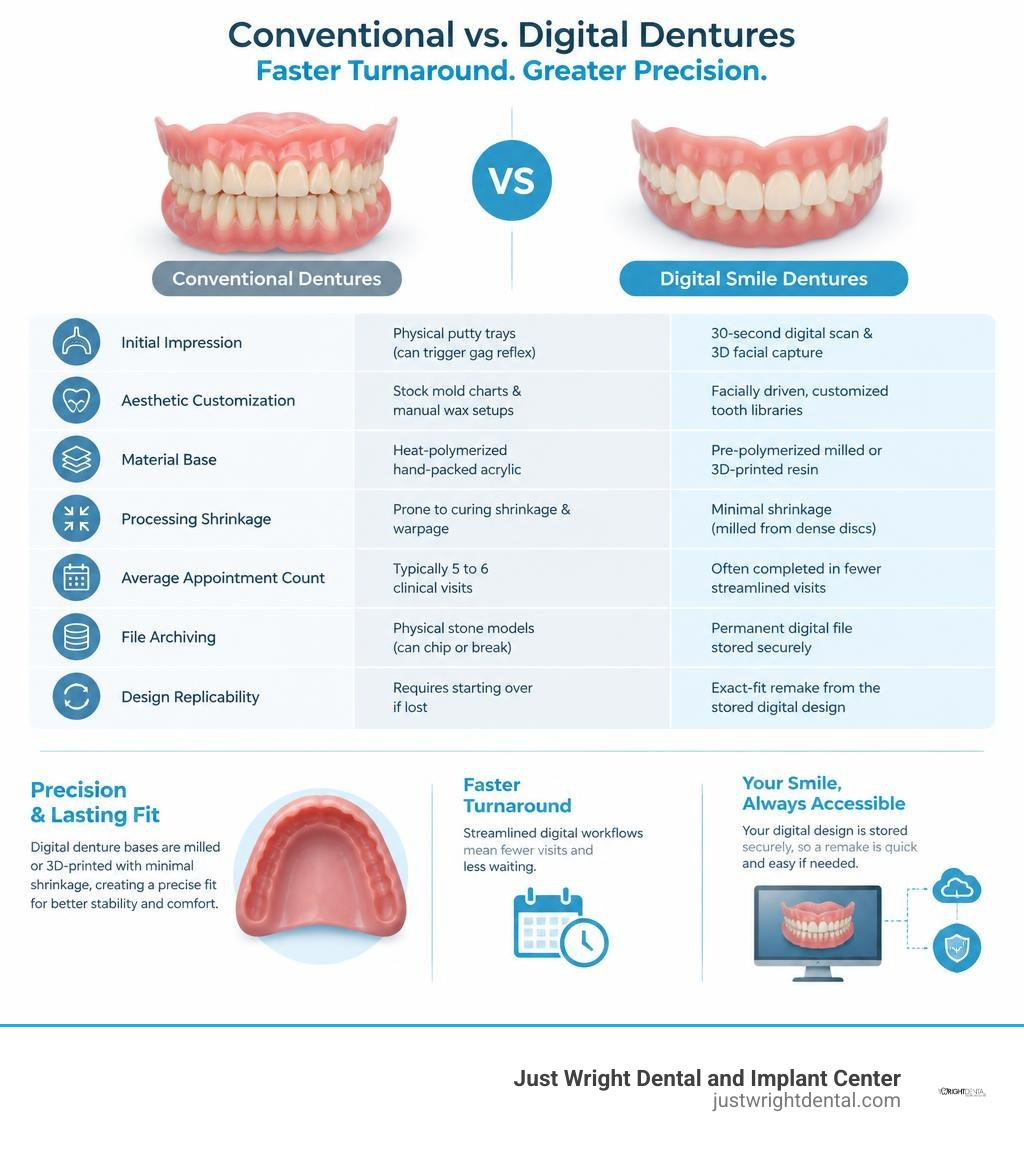
You might wonder if a digital denture offers tangible advantages over the traditional approach used for decades. Conventional methods rely on messy alginate impression trays, hand-carved wax rims, and heat-cured processing that shrinks as it cools, while digital workflows deliver consistent precision and faster timelines.
Feature / Metric | Conventional Dentures | Digital Smile Dentures |
|---|---|---|
Initial Impression | Physical putty trays (can trigger gag reflex) | 30-second digital scan & 3D facial capture |
Aesthetic Customization | Stock mold charts & manual wax setups | Facially driven, customized tooth libraries |
Material Base | Heat-polymerized hand-packed acrylic | Pre-polymerized milled or 3D-printed resin |
Processing Shrinkage | Prone to curing shrinkage & warpage | Minimal shrinkage (milled from dense discs) |
Average Appointment Count | Typically 5 to 6 clinical visits | Often completed in fewer streamlined visits |
File Archiving | Physical stone models (can chip or break) | Permanent digital file stored securely |
Design Replicability | Requires starting over if lost | Exact-fit remake from the stored digital design |
A Digital versus Conventional Dentures clinical study found that digital CAD/CAM dentures offer superior upper and lower stability compared to conventional heat-polymerized versions. By streamlining the entire process, modern dentures eliminate guesswork while maintaining anatomical accuracy.
Clinical Retention, Stability, and Anatomical Fit
If you fear that a denture will slip during meals or conversations, base fit is the deciding factor. Traditional acrylic shrinks during the heating and curing cycle, which can cause micro-gaps between the acrylic base and your delicate gum tissue.
In our digital workflow, we mill denture bases out of dense, pre-polymerized discs of polymethyl methacrylate (PMMA) or print them with advanced biocompatible resins. Because these pucks are already fully cured under industrial pressure, they experience virtually zero shrinkage during fabrication. The base conforms closely to your unique bone ridges, supporting a reliable peripheral seal and comfortable suction.

Long-Term Benefits of a Denture Digital Smile for Edentulous Patients
Losing or breaking a conventional denture often means starting from scratch with multiple impression visits and weeks of waiting. A major advantage of digital smile design is that your approved 3D design is securely stored as a master digital record.
If you ever misplace or damage your appliance, we can access your file and run it through our in-house mills or 3D printers in a matter of hours or days. Clinical studies using the Oral Health-Related Quality of Life (OHIP-20) index demonstrate that predictable, well-fitting digital restorations give patients renewed comfort, clear speech, and daily eating confidence. You can see real-world transformations in our before and after smile transformation gallery.
Can Digital Smile Design Be Integrated with Dental Implants?
If you prefer a secure, non-removable solution that does not rely on gum suction, digital smile design integrates seamlessly with implant planning. We use prosthetically driven planning, meaning we design your optimal smile first, then place implants precisely where they will best support those teeth.
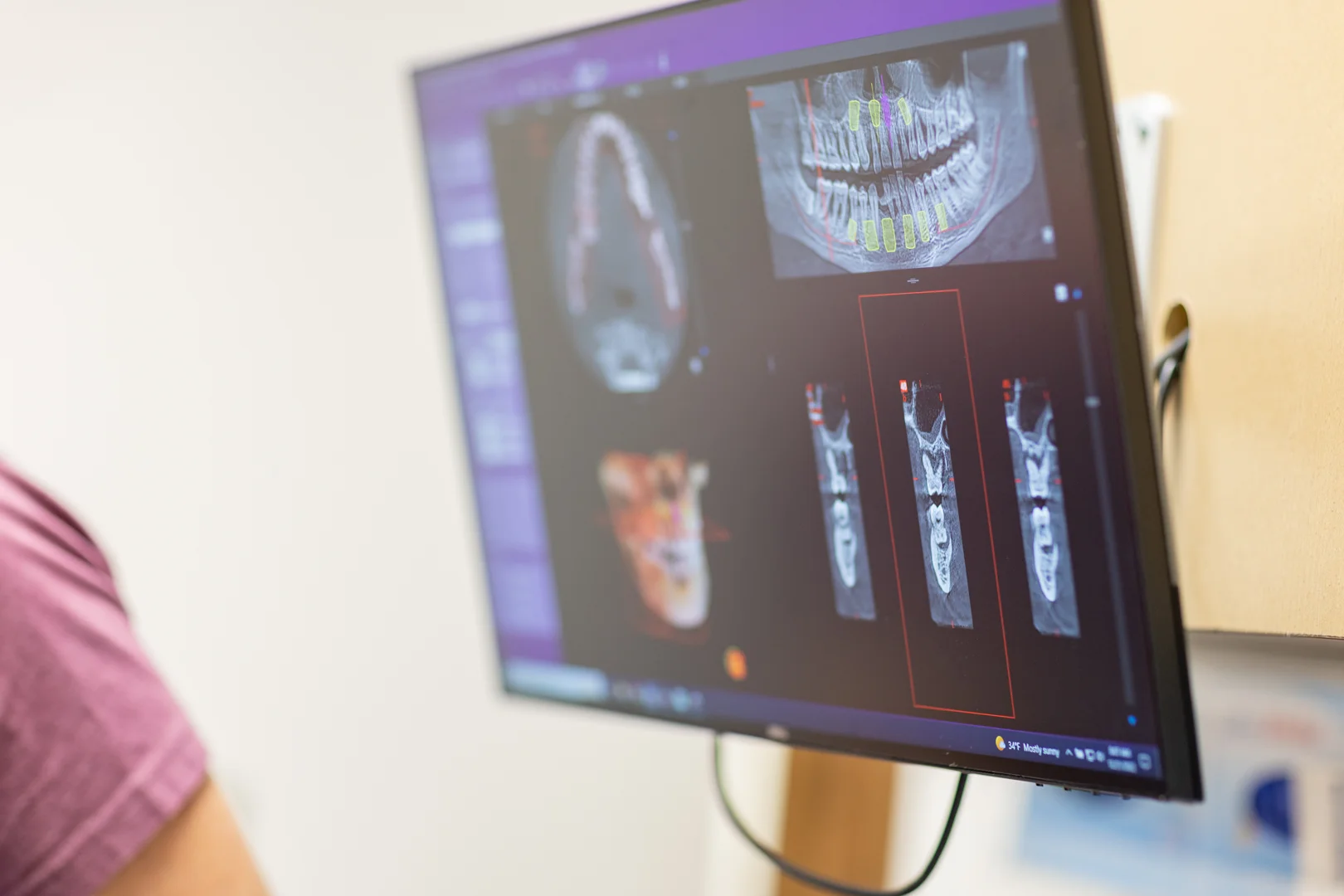
By combining your 3D digital smile design with a low-dose CBCT cone-beam scan, we assess bone density, nerve pathways, and sinus cavities. We then manufacture 3D surgical guides in-house to position implants with sub-millimeter accuracy. For individual dental implants, traditional all-on-four dentures, or a fixed full-arch bridge, the digital plan guides the final cosmetic and functional result. For patients facing significant bone loss, I can also plan remote-anchorage implants, such as zygomatic, pterygoid, transsinus, and transnasal implants placed in denser bone beyond standard jaw sites, providing solid foundations without extensive bone grafting.
Frequently Asked Questions About Digital Smile Dentures
How many appointments are needed for a digital smile denture?
Treatment timelines depend on your oral anatomy, whether extractions are needed, and the type of denture chosen. While conventional dentures often take five to six visits, an in-house digital workflow typically requires fewer appointments because scanning, design, and manufacturing happen under one roof without outside lab delays.
Can I preview and adjust my smile before the denture is fabricated?
Yes, you can evaluate your smile preview both on a digital screen and by wearing a 3D-printed monoblock try-in. This prototype lets us check your tooth display, lip support, speech sounds, and midline in person, making any necessary adjustments before final production.
What makes the fit of a digitally designed denture more accurate?
Digital dentures avoid the dimensional distortion and material shrinkage common in hand-mixed plaster and heat-cured acrylics. By capturing exact tissue contours with optical scanners and milling the base from dense, pre-cured PMMA discs, the denture adapts closely to your gums for reliable retention.
What happens if I lose or damage my digital denture?
Because your approved design is saved as a digital master file, we can produce an exact duplicate on our in-house CAD/CAM mills or 3D printers without taking new impressions, provided your gum tissue has not changed. A quick clinical check confirms that the new prosthetic seats comfortably.
Conclusion
A confident smile should look natural, fit comfortably, and complement your facial features. Through advanced 3D scanning, facially guided virtual design, and 100% in-house digital manufacturing, modern denture design eliminates guesswork so you know what your smile will look like before it is finished.
At Just Wright Dental and Implant Center in Corsicana, Texas, we handle your entire care process under one roof—from digital scans and surgical planning to in-house milling on our 12 CAD/CAM mills and 4 3D printers. For patients traveling from Waxahachie, Ennis, Waco, Midlothian, or across the country, we provide clear options tailored to your needs.
You can book an appointment online to start the conversation and explore what is possible for your smile.
Author Bio
Dr. Justin Wright, DDS is the founder and clinical director of Just Wright Dental and Implant Center in Corsicana, Texas. With 18 years in practice, he has placed more than 10,000 dental implants and completed more than 1,000 full-mouth reconstructions, utilizing an entirely in-house 3D digital workflow.
References
Shingane S, Rupam S, Pandey S, Singh S, Sharma S, Lath V. "Designing the Smile in Complete Denture Patient: An Ingenious Approach.." Journal of pharmacy & bioallied sciences, 2024. PMCID PMC11805011.