
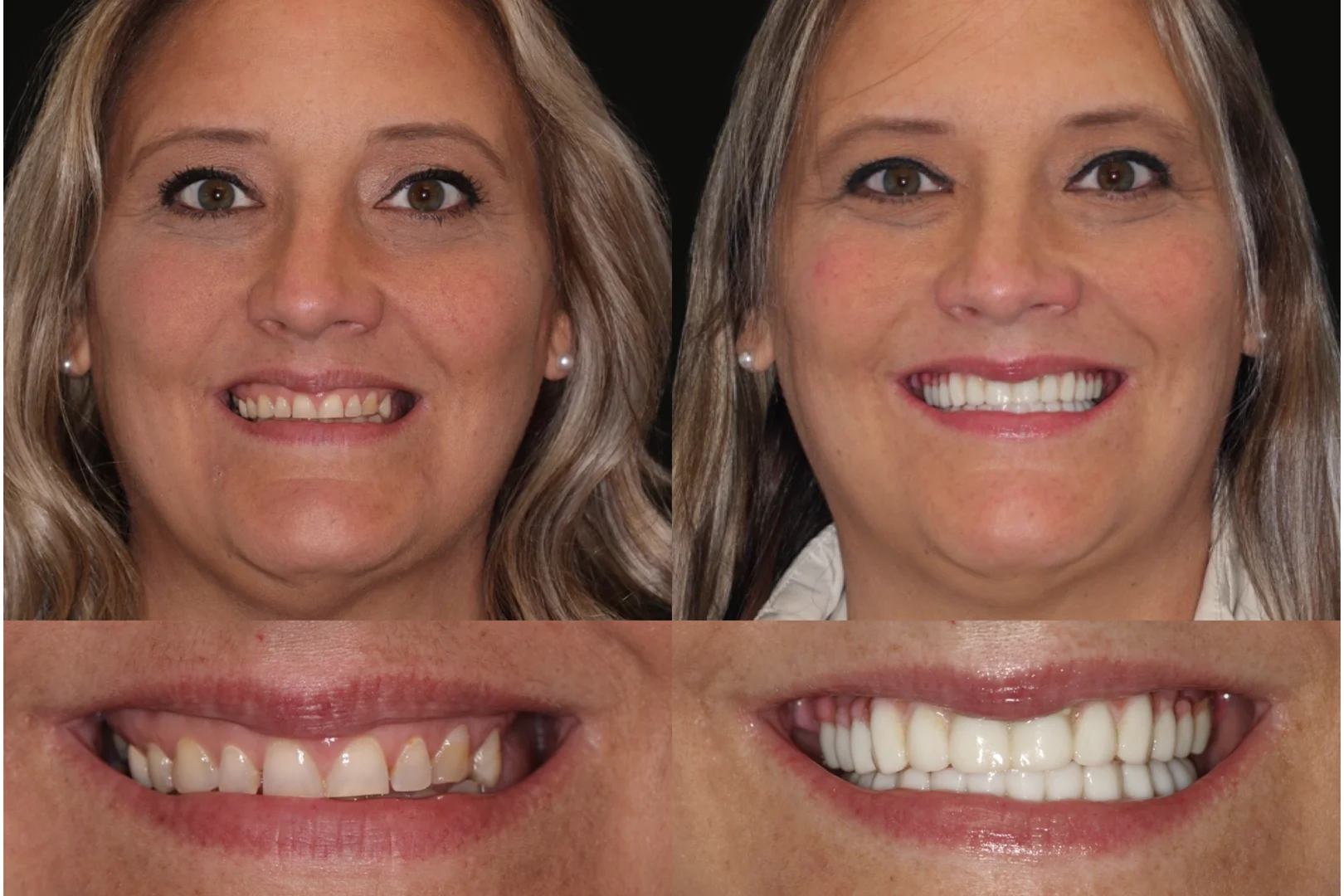
Are Full Mouth Veneers Right for Your Smile? Cost and Process
Full Mouth Veneers: Cost, Process, and Smile Makeovers
Full mouth veneers usually cover the teeth you see when you smile, not every tooth. A plan may include 8 to 10 upper teeth or 16 to 20 teeth across both arches. Your investment depends on how many teeth are treated, the material you choose, your bite, and whether some teeth need crowns instead of veneers.
The process starts with an exam and a smile plan. From there, I can show you which teeth need treatment, what preparation may be needed, and how the finished smile could fit your face.
I'm Dr. Justin Wright, DDS. At Just Wright Dental and Implant Center, I draw on more than 18 years of restorative work and use digital smile design and our in-house lab to plan full mouth veneers around your teeth and bite.
What Does a Full Mouth Veneers Smile Makeover Actually Entail?
A full-arch aesthetic transformation is a customized treatment plan designed to restore the shape, size, color, and symmetry of the teeth displayed in your aesthetic zone—the visible area when you speak and smile. We tailor every plan to your unique facial features and bite mechanics, so your new smile works in harmony with your jaw joints and muscles.

When we plan a smile transformation, we look at far more than just individual tooth shade. We examine your lip dynamics, the curve of your lower lip, your gum architecture, and how your teeth contact when chewing. You can read more about how dental veneers work to improve aesthetics while preserving healthy underlying structure. Our goal is to create natural balance so your smile looks lifelike, feels comfortable, and functions without unnecessary strain.
How Many Teeth Are in a Full Set vs. Full Mouth Veneers?
A "full set" of veneers seldom means treating all 32 teeth in your mouth. For most people, a full upper makeover involves 8 to 10 front teeth (the upper anterior aesthetic zone), while a comprehensive dual-arch case typically totals 16 to 20 teeth across both your upper and lower arches.
The exact number depends primarily on your arch width and the "buccal corridor"—the dark space visible in the corners of your mouth when you give a broad smile. If you have a wide smile line, you may show ten or twelve teeth across the top; if you have a narrower smile, eight restorations might frame your visible smile beautifully. You can explore how we personalize these smile transformations to match individual facial anatomy.
Why Might Molars Receive Crowns Instead of Veneers?
Back teeth often receive full-coverage crowns rather than veneers because your molars bear heavy chewing pressures. While thin ceramic shells work exceptionally well on front teeth that shear food, they aren't designed to withstand the intense vertical grinding forces exerted on posterior teeth.
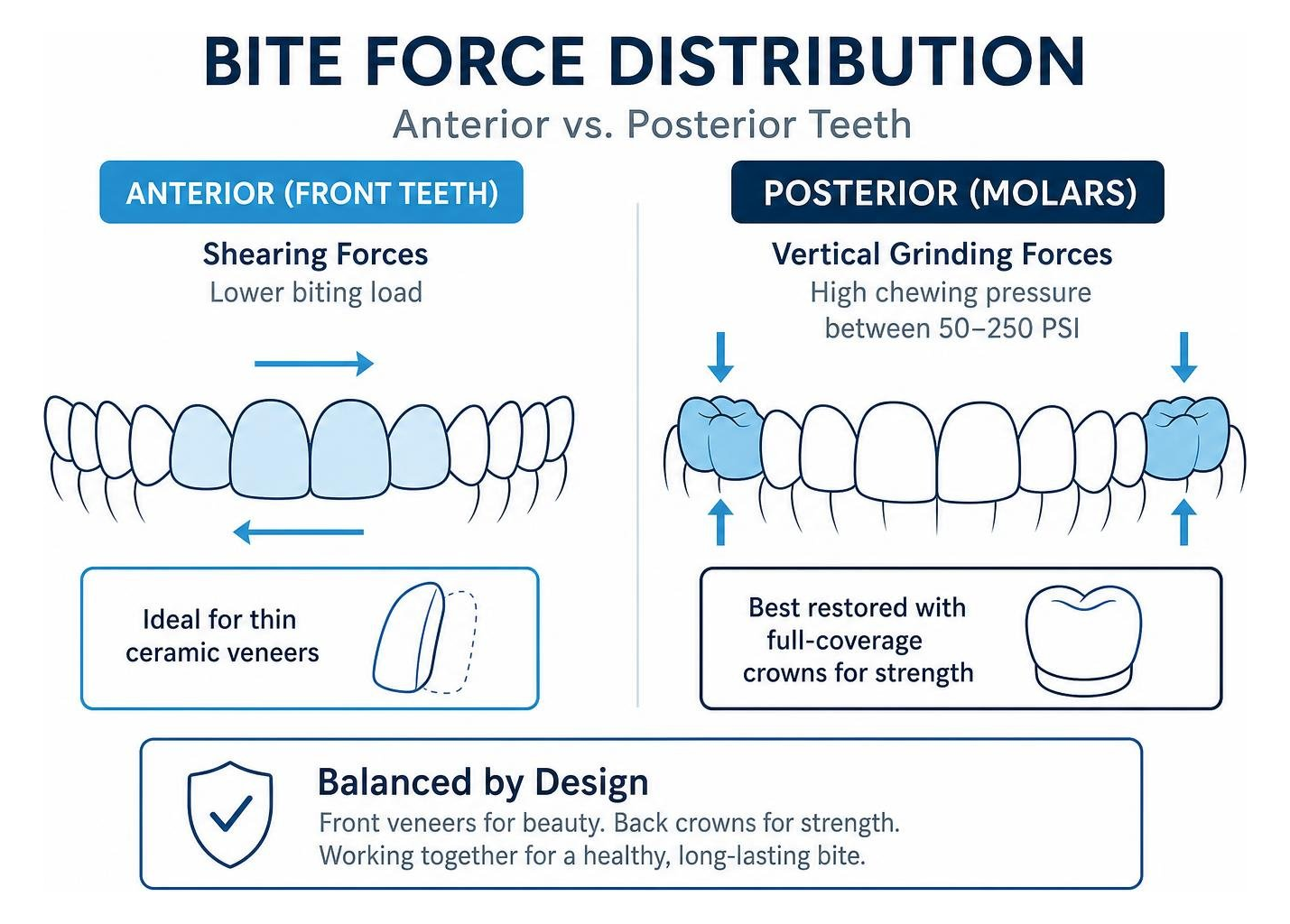
Placing a veneer on a molar can lead to early debonding or structural fractures under heavy functional loads. In a comprehensive Hollywood smile makeover, we frequently perform a hybrid reconstruction: placing custom veneers on the anterior front teeth for lifelike beauty and full-coverage crowns on the back molars to restore structural strength and maintain proper bite height.
How Much Does a Complete Smile Makeover Cost in 2026?
The total financial investment for a complete smile makeover depends on the number of restorations required, the material selected, and the clinical complexity of your bite. Because every mouth presents unique functional demands, there's no single universal fee for a full makeover.

When budgeting for treatment in 2026, you'll evaluate whether you need a single arch of 8 to 10 teeth or a full rehabilitation across both arches totaling 16 to 20 units. Factors such as preexisting tooth wear, bite misalignment, and gum recontouring also influence the final scope of care.
Porcelain vs. Composite: Comparing Full Mouth Veneers Materials and Lifespan
The primary decision regarding materials is choosing between high-strength ceramic porcelain and chairside composite resin. Porcelain provides superior translucency, unmatched stain resistance, and long-term durability, whereas composite offers a conservative, lower-investment option that requires more frequent maintenance.
Feature / Metric | Custom Porcelain Veneers | Composite Resin Veneers |
|---|---|---|
Primary Material | Lithium Disilicate / Feldspathic Ceramic | Micro-hybrid / Nanofill Composite Resin |
Typical Longevity | 10 to 15+ years with proper home care | 3 to 7 years before polishing or replacement |
Stain Resistance | Highly resistant to coffee, tea, and wine | Prone to surface staining over time |
In-Office Repairability | Generally requires full unit replacement | Can be touched up and polished chairside |
Aesthetic Translucency | Natural light reflection matching enamel | Good aesthetic match, slightly more opaque |
Porcelain mimics the natural optical properties of tooth enamel because light passes through the ceramic and reflects off the underlying tooth structure just like natural dentition. Composite resin can look great initially, but it tends to lose its luster and absorb dietary pigments over time.
Dental Insurance, Financing, and Medical Coverage Realities
Dental insurance policies classify aesthetic veneers as elective cosmetic treatments, meaning traditional dental plans rarely contribute toward veneer placement. However, medical plans and dental plans sometimes cover restorative components—such as full crowns, bite corrections, or reconstruction related to trauma, infection removal, or TMJ dysfunction.
At Just Wright Dental and Implant Center, our full-time Medical Insurance Coordinator works directly on your behalf to verify and bill medical insurance when functional restoration, bone grafting, or joint deficits are involved. For elective aesthetic care, flexible third-party healthcare financing options allow you to divide your overall health investment into manageable monthly installments.
What Factors Affect the Cost of a Full Smile Makeover?
The overall investment for your smile transformation is determined by several interrelated clinical variables, ranging from your preparation requirements to the quality of the fabricating laboratory.
Investment Factor | Clinical Influence on Treatment Scope |
|---|---|
Number of Units | Treating 8 upper teeth requires fewer materials and less clinical time than a 20-unit dual-arch case. |
Material Selection | Premium lithium disilicate ceramic represents a higher upfront investment than composite resin. |
Case Complexity | Severe wear, uneven gumlines, or collapsed bites require extensive planning and restorative steps. |
Fabrication Method | On-site CAD/CAM milling eliminates third-party lab surcharges and allows same-day precision adjustments. |
Preparatory Care | Addressing underlying tooth decay, gum inflammation, or bite alignment before bonding adds clinical steps. |
What Is the Step-by-Step Procedure and Recovery Process?
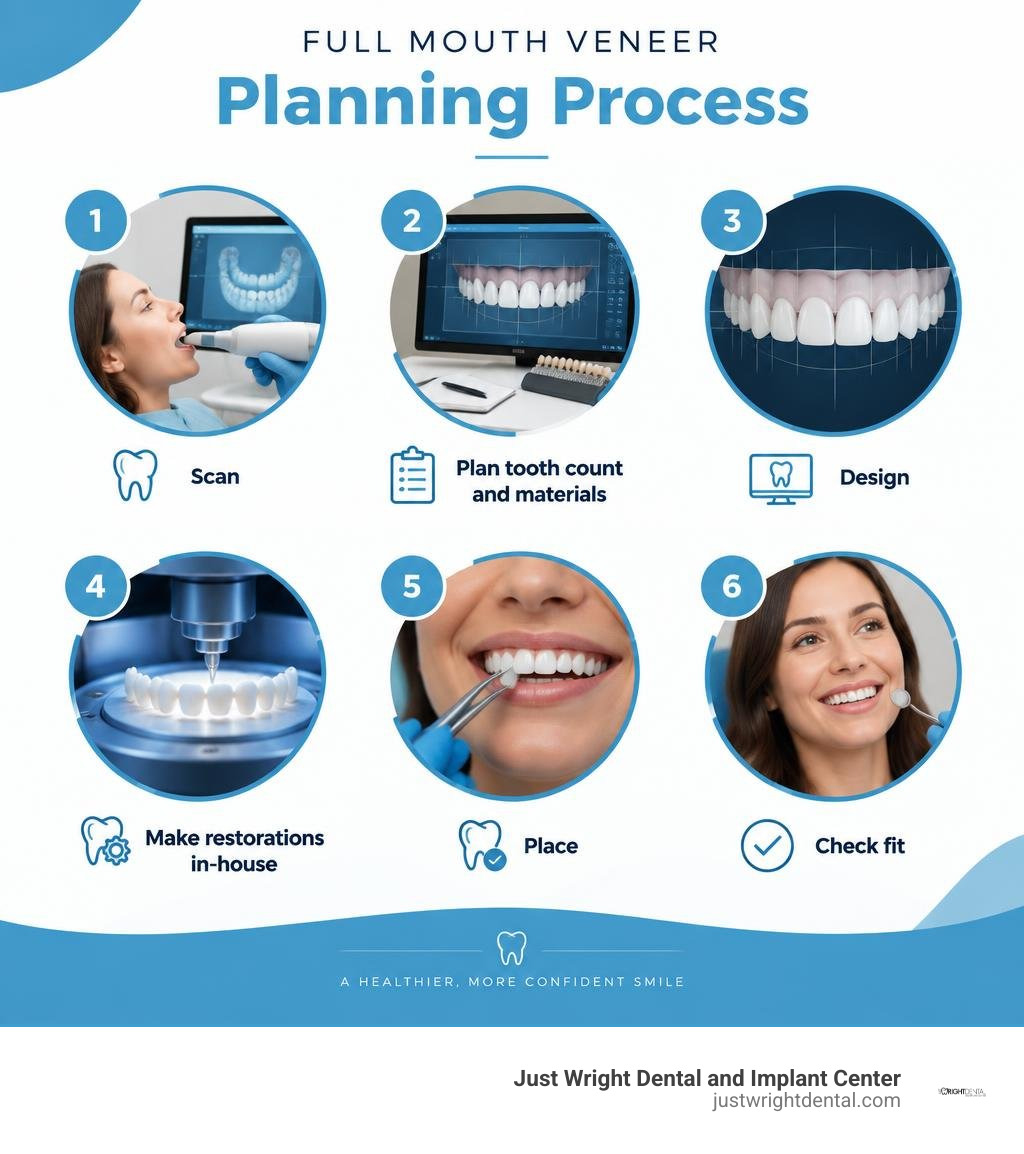
Your smile makeover involves a systematic sequence: an initial 3D digital exam, custom digital smile design, conservative tooth preparation, fabrication of your restorations, and final bonding. It's designed to keep you comfortable while delivering exact fit and aesthetics.
During your initial consultation, we capture high-resolution intraoral scans and 3D facial imaging to assess your dental health. You can explore our educational library at the Smile Education Center to learn more about the technologies we use. Once your smile is planned digitally, we prepare the teeth conservatively under gentle local numbing medication, capture final digital impressions, and create temporary prototypes so you can test-drive your new smile before the final ceramics are placed.
How Does In-House Digital Design and Milling Support Precision?
At Just Wright Dental and Implant Center, we don't use generic stock templates or rely on outside commercial laboratories. We design every smile in 3D directly from your facial proportions and anatomy, planning every contour prosthetically using advanced imaging.

All restorations are crafted in-house utilizing our in-house CAD/CAM milling and 3D printing equipment. Our master dental lab technicians work chairside in the treatment room alongside me. This direct collaboration eliminates weeks of waiting for outside shipments and allows us to make immediate, real-time micro-adjustments to shade, shape, and bite contact while you're seated in the chair.
Is Tooth Preparation Permanent, and What Are the Risks?
Traditional veneer placement involves conservative enamel reduction, making the treatment an irreversible process. Because a fraction of a millimeter of outer enamel is carefully shaped to help the final ceramic sit flush with your gumline, those teeth will require a protective restoration going forward.
The primary risks include temporary tooth sensitivity to hot and cold liquids, which typically resolves within a few days to weeks after bonding. Maintaining sound enamel depth during preparation is critical; bonding ceramic to enamel creates an exceptionally durable bond, whereas bonding to deeper dentin carries higher risks of future debonding. You can explore how we balance beauty and tooth preservation through our cosmetic dentistry services.
Who Is an Ideal Candidate for a Full-Arch Transformation?
An ideal candidate for a comprehensive smile makeover is someone with healthy gums, structurally sound teeth, and a stable bite who wants to correct aesthetic concerns like severe discoloration, chips, worn edges, or minor spacing.
Before we place aesthetic restorations, any active oral health issues must be resolved. Periodontal disease or active tooth decay will compromise the foundation of your restorations, just like building a house on shifting soil. You can view real-life results from our past cases in our before and after smile transformation gallery. If you have severe tooth crowding or significant bite misalignment, we may recommend clear aligners to align your teeth into optimal position before veneer preparation.
What Candidacy Factors Matter, Including Enamel, Alignment, and Bruxism?
Several clinical factors dictate whether full-arch veneers are the right treatment path for your smile:
Sufficient Enamel Depth: Veneers require a healthy outer enamel layer for predictable, long-term resin bonding.
Absence of Severe Bruxism: Chronic, untreated nighttime grinding can fracture ceramic; if you grind, you must commit to wearing a custom protective nightguard.
Stable Gum Health: Gums must be free of inflammation, bleeding, or recession to establish clean, predictable margins.
Proper Bite Relationship: Severe crossbites or underbites place unfavorable angular forces on veneers, requiring orthodontic correction first.
How Can Aftercare Help Maximize Veneer Longevity?
Maximizing the lifespan of your full-arch restorations requires consistent daily hygiene and simple protective habits:
Brush with Non-Abrasive Paste: Use a soft-bristled toothbrush and non-abrasive fluoride toothpaste to prevent scratching the ceramic glaze.
Floss Daily: Clean thoroughly around the margins where the veneer meets the gumline to prevent recurrent decay on natural tooth surfaces.
Wear a Nightguard: Protect your investment from involuntary nocturnal clenching or grinding with a custom-fitted nightguard.
Avoid Using Teeth as Tools: Avoid using your restorations to bite fingernails, tear open plastic packaging, or chew on ice or hard candies.
Maintain Regular Cleanings: Visit our office every six months so our hygiene team can polish your restorations and verify bite stability.
Conclusion
A full-arch smile transformation is a life-changing investment that restores your confidence, facial balance, and dental function. By combining conservative tooth preparation, advanced ceramic materials, and in-house digital design, I craft smiles that look completely natural and are planned to hold up well over time.
Text or call Shelley, our Smile Transformation Coordinator, at 903-602-3439, or call our office at 903-872-8422. You can also schedule your personalized consultation.
Author Bio
Dr. Justin Wright, DDS, is the founder and clinical director of Just Wright Dental and Implant Center in Corsicana, Texas. With more than 18 years in practice, over 10,000 implants placed, and more than 1,000 full-mouth reconstructions completed, Dr. Wright utilizes an entirely in-house 3D digital workflow—featuring CAD/CAM milling, 3D printing, and chairside lab technicians—to deliver beautiful, predictable cosmetic outcomes tailored to each patient's facial anatomy.
Frequently Asked Questions About Smile Makeovers
How long do full-mouth porcelain veneers typically last?
With excellent home hygiene, routine dental cleanings, and nightguard use if you clench your teeth, high-quality porcelain veneers typically last between 10 and 15 years, and often reach 20 years. Their longevity depends largely on keeping the natural tooth structure underneath clean and free of decay.
Can you get veneers if you have missing teeth in your smile?
Veneers require an existing natural tooth to bond onto, so they can't replace a tooth that's entirely missing. In cases with missing teeth, we combine cosmetic veneers on your natural teeth with dental implants or aesthetic bridgework to deliver a completely seamless, full-arch restoration.
Do teeth decay or develop cavities underneath bonded veneers?
While the porcelain veneer itself is completely impervious to cavities, the natural tooth structure underneath and around the margins remains susceptible to decay. Practicing diligent brushing, daily flossing, and attending regular professional checkups helps keep your underlying teeth healthy and cavity-free.
Can porcelain veneers be whitened if they stain over time?
Traditional peroxide-based whitening gels don't change porcelain's shade. Porcelain also resists dietary stains from coffee or tea. If your restorations ever appear dull, our clinical team can safely polish them chairside to restore their original lustrous shine.
Is the tooth preparation process painful?
The preparation phase is kept entirely comfortable through the use of targeted local numbing medication that keeps the area numb throughout treatment. Afterward, you may experience mild, transient sensitivity to temperature changes for a few days, which quickly subsides as your teeth settle.