
The Ultimate Guide to Dental Payment Plans for Affordable Options
Dental Payment Plans Can Make Needed Care Easier to Budget
Dr. Justin Wright, DDS is the founder and clinical director of Just Wright Dental and Implant Center in Corsicana, Texas.
Dental payment plans let you divide an out-of-pocket dental investment into scheduled payments instead of paying the full amount at one visit. Before you agree to a plan, ask for the total amount financed, down payment, monthly payment, interest rate or promotional terms, fees, and what happens if a payment is late.
For many patients, the best choice is simple:
Use insurance, an HSA, or an FSA first when eligible.
Compare an in-house plan with third-party financing and a personal loan.
Choose the shortest payment term that fits your monthly budget.
Read deferred-interest terms carefully. Interest may be added retroactively if the balance is not paid in full by the deadline.
Dental care can range from routine visits to larger health investments, such as full-mouth implant restoration. At our one office in Corsicana, Texas, we discuss your budget before we build a clinical plan. We do not reduce the standard of care to reach a number; when needed, we adjust the scope of treatment and review financing options with you.
I am Dr. Justin Wright, DDS, and I have spent 18+ years helping patients make informed decisions about complex dental treatment and dental payment plans. Our team takes a judgment-free approach because financial questions should be clear before you decide what comes next.

What Are Dental Payment Plans and How Do They Work?
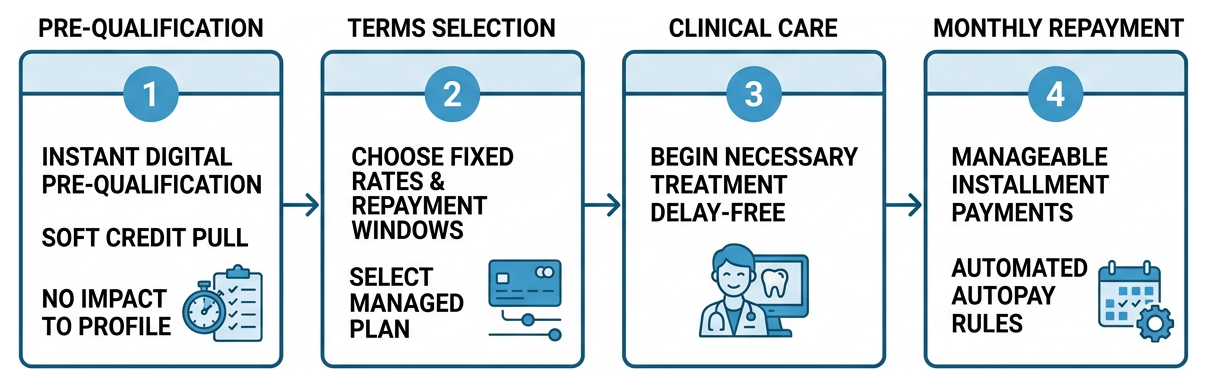
When facing restorative or aesthetic dental procedures, handling the entire health investment at once is often not feasible. Dental payment plans break down your total balance into predictable monthly installments, allowing you to proceed with necessary clinical care without delay.
Depending on the arrangement, you may enter an agreement directly with your dental practice or partner with a specialized third-party medical lender. Most plans establish a transparent agreement covering the down payment, installment timeline, finance charges, and auto-pay rules, keeping everything compliant with the Truth in Lending Act.
Feature | In-House Payment Plans | Third-Party Patient Financing |
|---|---|---|
Credit Check | Often none or soft evaluation | Soft check for pre-qualification; variable terms |
Interest Terms | Frequently interest-free or promotional | 0% promotional APR or fixed rates by credit tier |
Term Length | Typically short-to-medium duration | Flexible windows ranging from short terms up to extended multi-year terms |
Approval Speed | Same-day administrative setup | Fast or minutes-long digital pre-qualification |
Administration | Handled directly by office staff | Managed through a specialized lending portal |
Interest-Free In-House Dental Payment Plans
In-house agreements are arranged directly between you and your provider. Because no external financial institution is involved, these arrangements frequently bypass rigid underwriting criteria.
Typically, a practice will request a reasonable deposit on the day treatment begins, spreading the remaining balance across an agreed-upon monthly schedule. For patients seeking straightforward terms without managing another credit account, exploring interest-free dental payment options provides a predictable, fee-free path forward.
Third-Party Dental Payment Plans and Buy Now Pay Later Options
Third-party lenders and modern Buy Now, Pay Later (BNPL) platforms offer dedicated lines of credit or installment loans designed specifically for healthcare.
These programs review applications in real time through soft credit pulls that do not impact your credit profile during the inquiry stage. By utilizing a comprehensive financing marketplace, patients gain access to competitive fixed rates, varying repayment terms, and manageable monthly payments that fit their household cash flow.
What Are the Typical Health Investments for Common Dental Procedures?
Health investments for dental care scale from modest amounts for routine preventive visits up to significant commitments for full-arch implant reconstruction. Understanding where your treatment falls on that spectrum helps you select the right payment strategy.
We believe in complete transparency so you can budget effectively.

Routine and Preventive Care Health Investments
Preventative care forms the baseline of long-term oral health. Addressing small issues early protects both your teeth and your budget:
Comprehensive Exams & Digital Imaging: Routine diagnostic visits help identify underlying issues before they require complex intervention.
Periodontal Therapy & Cleanings: Specialized hygiene appointments keep gum tissue healthy and prevent progressive bone loss.
Tooth-Colored Fillings: Modern composite resin restores decayed structures while blending seamlessly with your natural tooth shade.
Prioritizing routine general dentistry prevents minor concerns from escalating into extensive restorative procedures.
Major Restorative and Cosmetic Treatment Expenses
When teeth suffer significant structural damage, wear, or aesthetic concerns, comprehensive restorative treatments rebuild both bite function and appearance:
Porcelain Crowns: Custom crowns protect weakened teeth after trauma or extensive decay.
Root Canal Therapy: Endodontic therapy relieves deep nerve infection, allowing you to preserve your natural root structure.
Aesthetic Smile Enhancements: Custom porcelain veneers reshape and brighten teeth to create a balanced smile profile through aesthetic cosmetic dentistry.
Removable Prosthetics: For full-arch tooth replacement without surgery, custom dentures offer functional stability.
Advanced Reconstruction and Implant Investment
For severe tooth loss, failing previous dental work, or complex structural breakdown, advanced implant dentistry provides durable stability.
Single and Multiple Implants: Titanium or zirconia posts replace missing roots, topped with custom abutments and crowns.
Full-Arch Restorations (All-on-X): Anchoring a complete arch of teeth on strategically placed implants restores chewing strength and aesthetics.
Remote-Anchorage Implants: For individuals told by other offices that they have insufficient bone, remote-anchorage implants (zygomatic, pterygoid, transsinus, and transnasal) utilize dense facial bones to secure a durable long-term restoration without extensive bone grafting.
Community-Based Alternatives: Patients exploring baseline introductory care options can also investigate accessible community care alternatives to compare various clinical pathways.
I plan each case digitally from your unique 3D facial anatomy. In our practice, we utilize 12 CAD/CAM milling units and 4 3D printers right here in our office. Because we never rely on an outside commercial lab, our team fabricates high-precision restorations—including same-day Smile-in-a-Day provisional teeth—allowing you to test-drive your new smile while healing. Learn more about our approach to advanced dental implants.
What Types of Dental Financing Options Are Available to Patients?
Patients generally choose among four main categories: healthcare credit cards, buy-now-pay-later platforms, pre-tax accounts such as HSAs and FSAs, and personal or credit union loans. The right fit depends on the scale of your treatment, your credit history, and your preferred repayment timeline.

Healthcare Credit Cards and Revolving Lines of Credit
Specialized healthcare credit cards function like standard revolving credit lines but are restricted to approved medical and dental providers.
The Benefit: Many offer promotional periods featuring zero interest if the balance is paid within 6, 12, or 24 months.
The Tradeoff: If the balance is not cleared before the promotional window closes, retroactive interest rates (often exceeding 25% APR) can be applied to the initial balance.
Buy Now Pay Later and Point-of-Sale Lending
Modern point-of-sale financing platforms deliver rapid approvals directly in the dental office. Platforms like Cherry provide lending limits suitable for major procedures with approval decisions in seconds. These platforms typically use soft credit inquiries to establish fixed APR tiers and clear monthly payment schedules without hidden administrative charges.
FSAs, HSAs, and Pre-Tax Healthcare Accounts
Flexible Spending Accounts (FSAs) and Health Savings Accounts (HSAs) allow you to direct pre-tax earnings toward eligible medical and dental procedures.
Using pre-tax dollars effectively lowers the overall health investment of your procedure by reducing your taxable income. You can use HSA or FSA funds directly via a benefits debit card or reimburse yourself after making your initial down payment.
Personal Loans and Credit Union Financing
For extensive full-mouth reconstructions, unsecured personal loans or financing through a local credit union offer fixed interest rates and predictable amortization terms. These loans generally offer longer repayment windows than point-of-sale platforms, keeping monthly payments manageable across multi-year schedules.
Can Patients with Bad Credit Qualify for Dental Financing?
A less-than-perfect credit score should not prevent you from receiving essential dental care. Many modern healthcare lenders utilize alternative underwriting models that evaluate steady income and banking history rather than relying solely on traditional credit scores.

Key pathways for patients rebuilding credit include:
High-Approval Financing Platforms: Lenders such as Healthcare Finance Direct (HFD) offer tiered approval structures designed to accommodate a broad spectrum of credit profiles.
In-House Installment Options: Office-managed plans generally bypass traditional credit scoring entirely, requiring only an initial down payment and an active checking account.
Co-Signer Arrangements: Applying alongside a creditworthy family member can unlock lower interest rates and higher financing limits for comprehensive restorative care.
How Can You Choose the Best Dental Financing Strategy for Your Budget?
Selecting the ideal financing strategy requires evaluating your total out-of-pocket budget against your monthly cash flow.
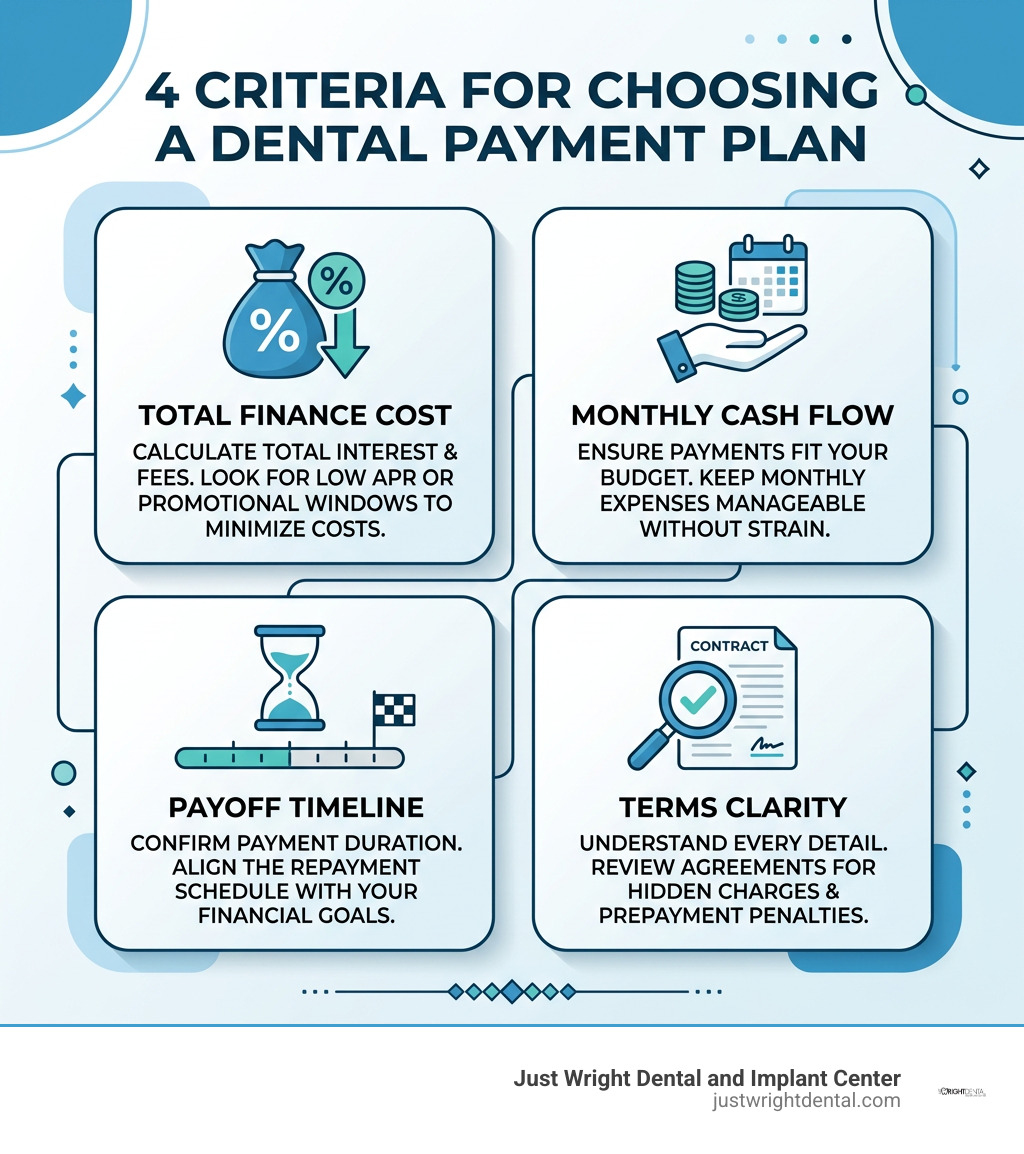
Evaluate Total Interest Charges: Calculate whether you can comfortably clear the balance during a zero-percent promotional window to avoid deferred interest fees.
Assess Monthly Cash Flow: Ensure your scheduled monthly payment fits smoothly into your regular living expenses without strain.
Review Prepayment Flexibility: Confirm that your chosen financing agreement permits early payoffs without penalty fees.
Consult Educational Resources: Review our Smile Education Center resources to understand every step of your clinical process before finalizing your financing choices.
Frequently Asked Questions About Dental Payment Plans
How do dental payment plans work without insurance?
If you do not have dental insurance, a payment plan divides your total treatment investment into regular monthly installments. You typically provide an initial down payment at your first appointment, and the remaining balance is scheduled via automatic monthly payments through an in-house agreement or third-party lender.
What is the difference between deferred interest and zero-percent APR?
A true 0% APR promotion does not charge interest during the specified term, and any unpaid balance after the promotional period simply accrues standard interest going forward. Deferred interest plans waive interest only if the balance is paid entirely within the promotional window; failing to do so results in interest being charged retroactively on the entire initial balance.
Can I use my HSA or FSA alongside a financing plan?
Yes. You can use pre-tax funds from an HSA or FSA to make the initial deposit or cover monthly installment payments for eligible restorative treatments. Combining tax-advantaged accounts with installment financing minimizes out-of-pocket expenses while keeping monthly budgeting predictable.
Will applying for dental financing hurt my credit score?
Most modern patient financing platforms perform a soft credit check during the initial pre-qualification phase, which has no effect on your credit score. If you choose to accept a specific formal loan offer, the lender may perform a standard hard credit inquiry to finalize the contract.
Can I pay off my dental financing balance early without penalties?
The vast majority of reputable healthcare lenders and in-house installment plans allow you to pay off your balance ahead of schedule without prepayment penalties. Settling your balance early can reduce total interest charges on interest-bearing loans and clear your revolving credit limit sooner.
Conclusion
Navigating dental care should center on your health, comfort, and peace of mind. At Just Wright Dental and Implant Center in Corsicana, Texas, our team provides personalized care in an environment that is welcoming, pressure-free, and respectful of your financial goals.
Our dedicated Medical Insurance Coordinator works on your behalf to handle preauthorizations, maximize benefits, and coordinate flexible payment plans tailored to your needs. Discover how our concierge patient services create a seamless experience from your very first conversation.
When you are ready to explore your options, claim your Free Smile Assessment to discuss a personalized treatment plan and make an informed investment in your long-term health.
Text or call Shelley, our Smile Transformation Coordinator, at 903-602-3439, or call our office at 903-872-8422.
About Dr. Justin Wright
Dr. Justin Wright, DDS is the founder and clinical director of Just Wright Dental and Implant Center in Corsicana, Texas.